Abstract
This study compares the effect of four different Acacia auriculiformis tree densities in an alley-cropping agroforestry system (AFS) on food crop yields and some properties of a ferralitic soil. The aims is to identify the one that would allow for settled agriculture. The study was conducted in Yangambi, DR Congo, and lasted eight successive growing seasons. The design consisted of four plots of 1042, 1250, 1563 and 2083 trees per hectare, arranged in corridors of 10 m, 8 m, 6 m, and 4 m respectively, as well as a control field without trees. This design was replicated six times on ground. Food crops were grown in the corridors in two rotational cycles, each cycle alternating rice, peanuts, maize, and cowpeas crops. The results show that the AFS corridors had a positive impact on yields for all crops. However, the impact of tree density was noted only in cowpea. Acacia auriculiformis also had an acidifying effect on the soil as pH values significantly decreased, particularly in the 6 m corridors. It increased soil carbon, particularly in the 4 m, 6 m, and 8 m corridors, but had no impact on nitrogen. We suggest that the experiment be repeated after 7 years of age to study the long-term impact.
Keywords: Acacia auriculiformis, agroforestry corridor, crop yield, pH, organic carbon
INTRODUCTION
The fertility of ferralitic soils is rapidly declining in tropical regions following continued cultivation. Extensive land is being left uncultivated and abandoned, forcing farmers to roam in search of fertility and higher yields. Faced with a rapidly growing population and increasing demand for land and wood products, natural forests are inexorably declining due to their conversion to agricultural land (Keenan et al., 2015; Curtis et al., 2018) and the use of inappropriate agricultural methods (Kang, 1997). Fallow periods are becoming shorter, leading to losses of soil organic matter (SOM) (Lal, 2000; Rosenzweig and Hillel, 2000) and a decline in soil productivity.
Little by little, a vicious circle is established including food insecurity, persistent poverty, climate change, loss of biodiversity, etc. which, unfortunately, thwarts the achievement of one of the Millennium Sustainable Development Goals (SDG2), the one specifically aiming for zero hunger by 2030 (Osgood-Zimmerman et al., 2018).
Several researchers have suggested that agroforestry can offer a sustainable alternative (Kidd and Pimentel, 1992; Nair, 1993, 1998; Young, 1997), by limiting soil degradation and thereby improving food security (Sanchez, 2002; Dubiez, 2018). Agroforestry, in fact, is one of the multifunctional agricultural systems that contribute to environmental and social objectives, without necessarily being increasingly productive (Waldron et al., 2017; Nair et al., 2021).
In agroforestry, the tree component can fix and store atmospheric carbon in addition to that stored in the soil carbon pool (Gavenda et al., 2000). The associated leguminous species, including Acacia auriculiformis, fix atmospheric nitrogen after nodulation with a range of Rhizobium and Bradyrhizobium strains. Also associated are ecto- and endo-mycorrhizal fungi whose symbiosis provides proven benefits to intercropping.
In general, agroforestry and alley cropping in particular are currently enjoying some success in the DRC, with an increase in reforestation projects and programmes using Acacia auriculiformis. Several studies (Bernhard-Reversat et al., 1993; Gnahoua et al., 2013) have demonstrated that Acacia sp. plants produce, in the environments where they have been introduced, relatively more aboveground biomass per unit of time than several native species. These tree legumes have very rapid growth rates (Dommergues et al., 1999; Singh et al., 2004) and have, among other things, a high potential for producing abundant litter (Bernhard-Reversat et al., 1993; Gnahoua et al., 2013), which can boost soil fertility through recycling nutrients pumped from deep horizons (Gbemavo et al., 2010).
While many authors have highlighted this undisputed multifunctional advantage of improving soil fertility and increasing crop yields (Moubarak et al., 2012, Kuyah et al., 2019; Piato et al., 2020; Koutouleas et al., 2022), some authors have, however, highlighted the competitive interactions between trees and crops for water, nutrients (van Noordwijk et al., 1996; Jose et al., 2000; Lose et al., 2003; Oelbermann et al., 2004), as well as for light (Boubacar, 2006). Similarly, issues related to tree densities and their effect on the development of intercropping in alley-cropping have not yet been documented.
Such a gray area deserves to be clarified by comparing in a study the fertilizing advantages of leaf biomass with its disadvantages related to competition for light and soil nutrients, in order to establish thresholds compatible with optimal crop growth. Indeed, when planted very densely, AFS trees provide more litter to the soil, but are likely to very quickly shade the corridors and crops, competing with them for water, light, and nutrients, limiting yields. Conversely, when planted less densely, litter supply decreases proportionally, as does competition.
In a study in Costa Rica, Oelbermann et al. (2002) showed that soil carbon increased significantly in alley cropping systems over a 19-year period using a minimum tree density of 555 trees ha−1 for E. poeppigiana and 3333 trees ha−1 for G. sepium.
There is therefore a need for further studies to be conducted to determine, specifically for the case under study, the density(s) of AFS trees that are able to reconcile the various factors (light, soil) and establish a favorable ecological balance for optimal intercropping yields.
For this reason, we initiated this study with the aim of identifying, among the four AGF tree density schemes tested, the one(s) that would offer better food crop yields and favorable soil fertility attributes. In the area where this study is conducted, the agriculture practiced is of the subsistence type, which uses very little or no mineral fertilizers.
The main aim of this study is to compare the effect of four A. auriculiformis alley cropping densities on crop yields and selected soil properties, in order to identify the one(s) that would achieve optimal and stable food crop yields and better soil fertility parameter thresholds.
This work compares the effect of four different densities of Acacia auriculiformis trees in an alley-cropping agroforestry system (AGF) on food crop yields and the properties of a ferralitic soil, in order to identify the density that would allow for the establishment of settled agriculture.
We hypothesized that: (1) A. auriculiformis alley cropping corridors have higher crop yields compared to the control without A. auriculiformis; (2) Crop yields are positively affected by densities ranging from 1,250 to 1,563 trees per hectare and negatively affected by densities outside this range; (3) Soils in A. auriculiformis AFS corridors are more acidic and have higher organic carbon and total nitrogen contents than those in the treeless control; (4) Acidity, soil organic carbon, and total nitrogen increase from minimum densities of 1042 trees per ha and above.
MATERIALS AND METHODS
The study area
The study was conducted in Yangambi, within the INERA Agricultural Research Center concession. This site is located between 0° 38' and 1° 10' N, 24° 16' and 25° 08' E, 100 km west of the city of Kisangani, in Isangi Territory, Tshopo Province, DR Congo (Boyemba, 2011).
The region receives an annual rainfall of 1839 ± 206 mm (1980–2012) with an average dry season of 3.3 ± 1.3 months, an average monthly rainfall of less than 100 mm, from December to March. Temperatures are high throughout the year, fluctuating between 25.5 ± 0.6°C (maximum) in March and 24.2 ± 0.4°C (minimum) in July (Kearsley, 2017). According to Koppen’s (1936) classification system, the study site belongs to the Af climate zone.
The soils of the Yangambi Plateau are Xanthic Ferralsols (WRB, 2014), mainly formed from fluvio-eolian sediments and composed primarily of quartz sands, kaolinitic clay, and hydrated iron oxides (Van Ranst, Baert, Ngongo, and Mafuka, 2010).
The previous cropping consisted of scrubland containing a mixture of Panicum sp., Paspallum conjugatum, etc.
Description of the agroforestry system
The plant material consisted of an agroforestry leguminous species: Acacia auriculiformis, and four food crop species: upland rice (Oriza sativa L., Nerica 7 variety), peanut (Arachis hypogaea L., G17 variety), maize (Zea mays L., Mudishi 3 variety), and cowpea (Vigna unguiculata L., Diamant variety). The sowing-flowering and sowing-ripening times were 75 and 100 days for rice, 30 and 90 days for peanut, 59 and 100 days for maize, and 45 and 65 days for cowpea, respectively.
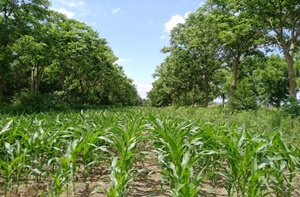
The experimental unit consisted of a control field (T0) not bearing A. auriculiformis, measuring 4m x 8m, and four A. auriculiformis-based AFS plots. The four plots or corridors (AFS T1, T2, T3, and T4) are delimited on either side of their width by a double row of A. auriculiformis planted at a spacing of 2m x 2m. They are 8m long and 10m, 8m, 6m, and 4m wide, respectively. The densities of AFS trees per hectare were 1042, 1250, 1563 and 2083 plants, respectively. The system was repeated six times within the space (Figure 1).
The healthy and vigorous A. auriculiformis seedlings were planted on September 15, 2019. They were 10 months old and averaged 0.5 cm in diameter and 30 cm in height. This establishment was directly followed by the sowing of the first crop.
The corridors received two rotational crop cycles following the rice – peanut – maize – cowpea succession for each. The first cycle includes the B2019, A2020 and B2020 and A2021 seasons, while the second cycle includes the B2021, A2022 and B2022 and A2023 seasons (Figure 2). The pruned leaves and tender branches of Acacia began to be collected from August 2020, and every time after harvesting a crop, then applied to the soil as mulch.
Determination of soil chemical parameters
Soils were collected at the beginning of season A2019 and at the end of season A2023. For each plot, a composite sample was created from samples taken at the center and four corners, at a depth of 0–20 cm. A total of 30 composite samples (= 5 treatments x 6 replicates) were analyzed at the laboratories of the Faculty Institute of Agricultural Sciences (IFA Yangambi) to determine soil pH, organic carbon, and total nitrogen content.
The pH was determined using a high-impedance potentiometer, a pH meter, on a quantity of soil suspended in the same quantity of distilled water (10 cm3 soil/10 ml water).
The total nitrogen was determined using the Kjeldahl method. The soil sample was subjected to digestion, distillation, and titration: the finely ground soil was heated with concentrated sulfuric acid (H2SO4), the nitrogen converted to ammonia was fixed by H2SO4 to the state of SO4(NH4)2. Then, the ammonia formed was displaced from its compounds by concentrated sodium hydroxide, distilled by steam distillation, collected, and assayed with titrated H2SO4.
Soil organic carbon content was determined using the Loss on Ignition (LOI) method: the soil sample was burned at high temperatures (450°C), destroying the organic matter and releasing it in the form of carbon dioxide (CO2) and water vapor. After combustion, only the mineral fraction of the soil remained in the container.
Determination of crop yields
The yields of various crops were evaluated as dry grain weight per hectare. They were calculated using the formula : total dry grain mass (kg) multiplied by 100 divided by the area of the agroforestry plot (ares):
Crop yield (kg ha-1)=(Mass of product harvested in a corridor (kg))/(Area of alley-cropping plot (ha))
RESULTS
Effects of Acacia auriculiformis on crop yields
In general, yields showed a continuous decline from the first to the second cropping cycle, and from the first chronological season to subsequent ones, as shown in Figure 3.
From the third chronological season onward, yields in the «control» plots differed from those in the agf alleys, achieving significantly lower values. Similarly, they declined over time. In the agf alleys, yields remained equivalent during the two rotational cycles, between the four different alleys for the three crops: rice, peanuts, and maize. Differences between alleys were only observed for cowpea in both the first and second cycles, as shown in Figure 3. The yields of the four different crops in the chronological seasons are presented in Figure 3.
Cereals (rice, corn)
In the first cycle, average rice yields ranged from 1823 kg/ha for the control plots to 1800 - 1834 kg for the AFS plots. Analysis of variance did not indicate a significant difference in yields between the alleys and the control plots, nor between the alleys.
In the second cycle, however, rice yields in the AFS alleys ranged from 1586 to 1624 kg/ha, which were significantly higher than the control plots, which were estimated at 1136 kg/ha (Figure 3). Analysis of variance confirmed this significant difference. However, the AFS alleys did not show a significant difference in yields between them.
For maize grown in the 3rd chronological season, yields obtained in the 1st cycle ranged from 1148 kg/ha in the control plot to 1593-1791 kg/ha in the AFS plots. In the 2nd cycle, these yields decreased to 776.8 kg/ha in the control compared to 1160.7-1316 kg/ha in the AFS alleys. In both the 1st and 2nd cycles, yield differences between alleys and the control were highly significant, while the alleys did not show any significant difference between them.
Food leguminous plants (peanuts, cowpeas)
In the first cycle, peanuts produced average yields of 1202.3 kg/ha in the control and 1232–1350.1 kg/ha in the AFS alleys, while in the second cycle, yields ranged from 1067.5 kg/ha to 1187.7–1229.5 kg/ha, respectively. These yields indicate equivalence between the alleys and even between the control and the alleys, as shown in Figure 3.
The cowpea, meanwhile, showed four contrasting yield groups in the first cycle, ranked in descending order as follows: T3 ≥ T2 ≥ T1, and T4 = T0. In the second cycle, however, three groups stood out as follows: T2 = T3 = T4 > T1 > T0.
Effects of Acacia auriculiformis on selected soil fertility parameters
Analytical data on soil pH, total organic carbon, total nitrogen, and C/N ratio are presented in table 1.
Generally, soil pH ranged from 3.7 to 4.9 during the B2019 season and 3.8 to 4.6 in the B2022 season. Table 1 shows the variations in pH across the different plots at the beginning and end of the experiment.
pH values showed a downward trend over time for both the agf and control lanes. However, the differences noted were not significant between the beginning and end of the experiment, as shown in Table 1 of the analysis of variance, with the exception of lane T3, where water pH was significantly higher at the beginning of the experiment than at the end.
Regarding soil organic carbon, the experiment shows that the agf T4, T3, and T2 lanes have significantly higher levels compared to the control, i.e., 1.8%, 1.6%, and 1.6%, respectively, compared to 1.1% for the control. The agroforestry species therefore appears to have contributed to the significant increase in soil TOC.
As for nitrogen, values did not change during the experiment, ranging from 1.3 to 1.5‰ at the beginning and 1.1 to 1.6‰ at the end (Table 1). No significant difference was observed between the alleys and the control, nor, within a treatment, between the two periods.
The soil C/N ratio varied from 9.3 to 11.4 at the beginning and from 10.1 to 12.0 at the end of the trial. Therefore, the C/N ratio increased slightly, although the difference was not significant.
DISCUSSION
The results indicate that the «control» plots showed significantly lower yields than the agf alleys for all growing seasons after 2020.
From the 3rd chronological season onwards, the effect of A. auriculiformis had become noticeable, in fact, and gave the intercropped corridors significantly higher yield conditions compared to the control, particularly for maize (every two seasons) and rice (one season, B2021). This naturally reflects the continued decline in soil fertility in the control, in the absence of fertilizer application. This result corroborates that of Mohamed (2005) in western Sudan, who reported an increase in crop yields for sorghum intercropped with Acacia Senegal.
For both seasons B2019 and A2020, which correspond to the initial growth period of A. auriculiformis, the impact of this was naturally almost zero, the yields were equivalent between the plots under treatment and control, showing by this fact, that the plots associated with the treatments (T0, T1, T2, T3, T4) were homogeneous before the establishment of the plantations.
The positive impact of AFS corridors on yields was observed in both the first and second cycles for maize, cowpea, and, to some extent, rice, particularly in the second cycle. This validates our hypothesis, according to which AFS corridors with A. auriculiformis have higher crop yields, compared to the control without A. auriculiformis. This finding is consistent with Fadl et al. (2009) in a similar experiment in North Kordolan, Sudan, on peanut, sesame, and roselle crops, according to which yields were higher in intercropped crops associated with Acacia senegal than in the monoculture system.
With regard to cowpea specifically, our results contradict those of Saidou et al. (2012) who noted a lower yield of cowpea in intercrops associated with Acacia senegal compared to control fields, in the N’Dounga forest station (INRAN). 1042, 1250, 1563 and 2083
Similarly, the yields obtained for cowpeas in the first cycle and, to some extent, in the second cycle validate our hypothesis, according to which crop yields will be positively impacted by minimum densities of 1250 AFS trees ha-1 and negatively impacted by those of 2083 AFS trees ha-1 and beyond. Indeed, in the 1st cycle, yields in corridors T2, as well as those of T3 (respectively 1250 and 1563 AFS trees ha-1) are statistically higher than those in corridors T1 (1042 trees ha-1). While those of T4 (2083 trees ha-1) become statistically equivalent to the control. In the 2nd cycle, the same trend is also observed, only corridors with 2083 trees ha-1 continued to positively impact cowpea yields.
The decreasing water pH from the beginning to the end of the experiment, particularly for corridor T3, shows that Acacia auriculiformis had an acidifying effect on the soil in corridor T3, thus joining several authors (Dubiez et al., 2019; Koutika et al., 2014; Kasongo et al., 2009; Drechsel et al., 1991) who have shown that soils bearing Acacia auriculiformis are often more acidic than the control.
These authors also generally established that soils under nitrogen-fixing species experienced acidification. However, they do not agree with Saidou et al. (2012), who instead found an increase in pH compared to control fields.
pH levels generally fluctuated in the range from «very acidic» to «extremely acidic» according to the Mc Menamin scale. These pH results are consistent with those of Boyemba (2011), who found pH values between 3.96 and 4.04 for Yangambi soils, particularly for his three study areas with contrasting Pericopsis elata Warms densities. Similarly, Kearsley et al. (2017), Lokonda (2018), and Lokonda et al. (2018) found similar water pH values of 3.7 to 4.6 under both mixed and Gilbertiodendron dewevrei-dominated forest types in Yangambi and Yoko. The pH range found in this study indicates that iron and aluminum mobilization is more effective in maintaining high aluminium toxicity and even H+ ion toxicity in the soil solution, blocking nutrients and hindering humification.
Thus, soil organic matter, which represents the main indicator of soil quality, both for agricultural functions, i.e. production and economy, and for environmental functions, including carbon sequestration and air quality, presents generally low levels in Yangambi environments.
The agroforestry species therefore appears to have contributed to the significant increase in soil TOC, as found by Dubiez et al. (2019) and El Atta et al. (2013). This was also confirmed by Githae et al. (2011).
As for nitrogen, the values did not change during the experiment; they varied in the ranges of 1.3 to 1.5‰ at the beginning and 1.1 to 1.6‰ at the end (Figure 3). No significant difference was observed between the corridors and the control, nor between the two periods. The values found in this experiment are relatively higher than those found by Kearsley et al. (2017). The results contradict those of Dubiez et al. (2019) and Hashim et al. (2013) who found in their experiments that leguminous species increased the nitrogen level in soils.
The C/N indicator showed no difference between the control plots and the agf corridors. Acacia auriculiformis therefore did not influence the organic matter decomposition process, nor nitrogen mineralization and nitrification in the soil, unlike Dubiez et al. (2019), Nzila et al. (2002), Bernhard-Reversat (1996) and Tchichelle et al. (2017). The latter observed an increase in the mineralization and nitrification process, particularly under an Acacia plantation much older than ours.
Numerous studies have shown that the nitrogen-fixing capacity of legumes is variable and depends on the age of the plantation. Because of this, the thresholds and stocks of Carbon, Nitrogen and other nutrients often decrease in the soil (Szott and Palm, 1996), and generally start to increase significantly from 7-10 years of age (Deans et al., 1999; Feldpausch et al., 2004); C and N generally take values greater than the starting or reference values (Dubiez et al., 2019; Koutika et al., 2014; Macedo et al., 2008; Szott et al., 1999; Harmand and Njiti, 1998; Bernhard-Reversat, 1996; Drechsel et al., 1991).
Oelbermann et al. (2002) went as far back as 19 years to demonstrate the impact of alley cropping systems using various densities of E. poeppigiana and G. sepium.
This work has the methodological limitation of addressing the question at the initial growth stage, i.e., within the first 3 years of A. auriculiformis’s life. However, this is only the beginning of a short-, medium-, and long-term study of the entire life cycle of this AFS species and its impact on soils and agriculture in ferralitic soil conditions. Another limitation would be that the study only considered a few soil parameters, but this study conducted several laboratory soil analyses, which will be published later.
CONCLUSION
This study generally shows that when food crops are intercropped with the species Acacia auriculiformis, it creates an agroecological environment conducive to plant production, particularly for rice, maize, and cowpea. Indeed, significant yield differences were noted between the control and agroforestry corridors from the second crop rotation onward. This favorable environment is thought to be due to the improvement in certain soil fertility parameters, particularly organic matter levels, explained by the decomposition of pruned A. auriculiformis leaves and branches. Corridor T3 appears more favorable, particularly for cowpea cultivation, whose yields were relatively better compared to the other corridors.
The experiment also showed that the A. auriculiformis species increases current soil acidity. This acidifying effect was noted in the AFS plots of 1563 trees ha-1, where pH-water values were significantly lower at the end of the experiment. Furthermore, when compared with each other, the agroforestry corridors showed equivalent pH-water values regardless of the time. Organic carbon, on the other hand, significantly increased in the plots with densities of 2083, 1563, and 1250 trees ha-1 compared to the control.
We suggest that the experiment be repeated with A. auriculiformis at 7 to 10 years of age to further assess the medium- and long-term impact of this agroforestry species on soils and agriculture.
REFERENCES
Bernhard-Reversat F., Diangana D., Tsata M. (1993). Biomasse, minéralomasse et productivité en plantation d’Acacia mangium et Acacia auriculiformis au Congo. Bois et Forêt des Tropiques, 238: 35-43.
Bernhard-Reversat F. (1996). Nitrogen cycling in tree plantations grown on a poor sandy savanna soil in Congo. Appl. Soil Ecol., 4:161–172.
Bisiaux F., Peltier R., Muliele J.C. (2009). Plantations industrielles et agroforesterie au service des populations des plateaux Batéké, Mampu, en République Démocratique du Congo. BFT, 301: 21-32.
Boyemba B.F. (2011). Écologie de Pericopsis elata (Fabaceae), arbre de forêt tropicale africaine à répartition agrégée, Dissertation de Thèse, ULB.
Boubacar A. (2006). Effet du niveau d’élagage et de la distance dupied d’Acacia senegal sur la production du mil (Pennisetum glaucum en station. Mémoire d’Ingénieur des Techniques Agricoles, Université Abdou Moumouni deNiamey, p. 41.
Curtis P.G., Slay C.M., Harris N.L. (2018). Classifying drivers of global forest loss. Science, 361: 1108–1111.
Dagnelie P. (1973). Théories et méthodes statistiques, Tome I et II, Presse Agronomique de Gembloux, Belgique.
Deans J.D., Diagne O., Lindley D.K., Dione M., Parkinson J.A. (1999). Nutrient and organic-matter accumulation in Acacia senegal fallows over 18 years. For. Ecol. Manage., 124:153–167.
De Rouw A. (1990). The invasion of Chromolaena odorata (L.) King and Robinson (ex. Eupatorium odoratum) and competition with the native flora in a rain forest zone, South West Côte d’Ivoire. J. of Biogeography, 17: 581. 11 p.
Dommergues Y., Duhoux E., et Diem H.G. (1999). Les arbres fixateurs d’azote: caractéristiques fondamentales et rôle dans l’aménagement des écosystèmes méditerranéens et tropicaux avec référence particulière aux zones subhumides et arides. Edition DUMAS, Saint-Etienne, 475 p.
Drechsel P., Glaser B., Zech W. (1991). Effect of four multipurpose tree species on soil amelioration during tree fallow in Central Togo. Agrofor. Syst., 16 :193–202.
Dubiez E., Freycon V., Marien J-N., Peltier R., Harmand J-M. (2019). Long term impact of Acacia auriculiformis woodlots growing in rotation with cassava and maize on the carbon and nutrient contents of savannah sandy soils in the humid tropics (Democratic Republic of Congo). Agrofor. Syst., 93:1167–1178.
Feldpausch T.R., Rondon M.A., Fernandes E., Riha S.J., Wandelli E. (2004). Carbon and nutrient accumulation in secondary forests regenerating on pastures in central Amazonia. Ecol. Appl., 14:164–176.
Dupuy B., N’guessan K.A. (1991). Sylviculture d’Acacia mangium en Basse Côte d’Ivoire. Bois et Forêts des Tropiques, 225: 24-32.
El Atta H.A., Ibrahim A.M., Ismail A.A. (2013). Effect of Acacia spp. on soil properties in the highlands of Saudi Arabia. Life Sci. J., 10: 100-105.
Fadl K.E.M. (2009). Growth and yield of groundnut, sesame and roselle under Acacia senegal agroforestry system in North Kordofan, Sudan.
Floret C., Pontanier R. (2000). La jachère en Afrique tropicale. Rôles, aménagements, alternatives. Actes du Séminaire International, Dakar, du 13-16 avril 1999. Vol. 1, 777 p.
Gbemavo D.S.J.C., GlèlèKakaï R., Assogbadjo A.E., Katary A., Gnanglè P. (2010). Effet de l’ombrage du karité sur le rendementcapsulaire du coton dans les agro écosystèmes coton-karité du Nord Bénin. Tropicultura, 28:193-199.
Githae E.W., Gachene C.K.K., Njoka J.T., (2011). Soil physicochemical properties under Acacia senegal varieties in the dryland areas of Kenya. African Journal of Plant Science, 5: 475-482
Gnahoua G.M., Nguessan K.A., Ballé P. (2014). Les jachères de légumineuses arborescentes: sources potentielles de bois énergie et de service en Côte d’Ivoire. Journal of Applied Biosciences, 81: 7290-7297.
Gnahoua G.M., Oliver R., Nguessan K., Balle P. (2013). Production et retombées minérales des litières chez quatre espèces de légumineuses arborées, utilisées en amélioration de jachères, en zone forestière de Côte d’Ivoire. Journal of Applied Biosciences, 72: 5800-5809.
Guillaumet J.L., Adjonohoun E. (1971). La végétation de la Côte d’Ivoire. Mémoires ORSTOM, 50:157- 263.
Harmand J.M., Njiti C.F. (1998). Effets de jachères agro forestières sur les propriétés d’un sol ferrugineux et sur la production céréalière. Agriculture et Dévelopement, 18: 21–30.
Imo M. (2009). Interactions amongst trees and crops in Taungya systems of western Kenya. Agroforest Syst., 76: 265–273.
Kasongo R.K., Van Ranst E., Verdoodt A., Kanyankagote P., Baert G. (2009). Impact of Acacia auriculiformis on the chemical fertility of sandy soils on the Bateke plateau, DR Congo. Soil Use Manag., 25: 21–27.
Keenan R.J., Reams G.A., Achard F. (2015). Dynamics of global forest area: results from the FAO Global Forest Resources Assessment 2015. For. Ecol. Manage., 352: 9–20.
Koutouleas A., Sarzynski T., Bertrand B., Bordeaux M., Bosselmann A.S., Campa C. (2022). Shade effects on yield across different Coffea arabica cultivars—how much is too much? A meta-analysis. Agron. Sustain. Dev., 42: 55.
Koutika L.S., Epron D., Bouillet J.P., Mareschal L. (2014). Changes in N and C concentrations, soil acidity and P availability in tropical mixed Acacia and Eucalyptus plantations on a nutrient-poor sandy soil. Plant and Soil, 379: 205–216.
Krisnawati H., Kallio M. and Kanninen M. (2011). Acacia mangium Wild.: Ecology, silviculture and productivity. CIFOR, Bogor, Indonesia.www.cifor.cgiar.org.
Kuyah S., Whitney C.W., Jonsson M., Sileshi G.W., Öborn I., Muthuri C.W. (2019). Agroforestry delivers a win-win solution for ecosystem services in sub-Saharan Africa. A meta-analysis. Agron. Sustain. Dev., 39: 1–18.
Lokonda O. Wa Kipifo (2018). Structure forestière, propriétés physico-chimiques du sol et indices pédo-anthracologiques de perturbation comparés entre la forêt monodominante à Gilbertiodendron dewevrei (De Wild) J. Léonard et la forêt mixte adjacente. Cas de la Réserve forestière de Yoko, R.D. Congo. Thèse doctorale, Université de Kisangani, 171 p.
Lokonda M.O., Freycon V., Gourlet-Fleury S. and Kombele F. (2018). Are soils under monodominant Gilbertiodendron dewevrei (De Wild) J. Léonard and under adjacent mixed forests similar ? A case study in the Democratic Republic of Congo. Journal of Tropical Ecology, 34: 176–185.
Macedo M.O., Resende A.S., Garcia P.C., Boddey R.M., Jantalia C.P., Urquiaga S., Campello E.F.C., Franco A.A. (2008). Changes soil C and N stocks and nutrient dynamics 13 years after recovery of degraded land using leguminous nitrogen-fixing trees. For. Ecol. Manage., 255: 1516–1524.
Maldonado G., Louppe D. (1999). Plantations villageoises de Teck. Bois et Forêts des Tropiques, 262: 19-30.
Mohamed A.G. (2005). Improvement of traditional Acacia senegal agroforestry: Ecophysiological characteristics as indicators for tree-crop interaction on sandy soil in western Sudan. University of Helsinki.
Montagne P., Housseini M. (2000). Les jachères dans le bassin d’approvisionnement en bois de la ville de Niamey. Bois et Forêts des Tropiques, 266: 55-59.
Moubarak A.R., Abdalla M.H., Nortcliff S.M. (2012). Pennisetum typhoides yield and selected soil attributes as influenced by some tree types of the semi-arid tropics of Sudan. Journal of Arid Environments, 77: 96-102.
Nair P.K.R., Kumar B.M., Nair V.D. (2021). An Introduction to Agroforestry. Cham: Springer International Publishing.
NAS (1984). Leucaena: Promising forage and tree crops for the Tropics, National Academy Press, Second edition, Washington D,C, p. 100.
Nzila J.D., Bouillet J.P., Laclau J.P., Ranger J. (2002). The effects of slash management on nutrient cycling and tree growth in Eucalyptus plantations in the Congo. For. Ecol. Manage.,171: 209–221.
Oelbermann M., Voroney R.P., Gordon A.M. (2004). Carbon sequestration in tropical and temperate agroforestry systems: a review with examples from Costa Rica and southern Canada. Agriculture, Ecosystems and Environment, 104: 359–377.
Oelbermann M., Voroney R.P. et Kass D.C.L. (2004). Gliricidia sepium Carbon Inputs and Soil Carbon Pools in a Costa Rican Alley Cropping System. International Journal of Agricultural Sustainability, 2: 33-42.
Ouédraogo B. (2007). Filière bois d’énergie burkinabé: Structuration des prix et analyse de la répartition des bénéfices. Bois et Forêts des Tropiques, 294: 75-88.
Osgood-Zimmerman A., Millear A.I., Stubbs R.W., Shields C., Pickering B.V., Earl L. (2018). Mapping child growth failure in Africa between 2000 and 2015. Nature, 555: 41–47.
Pardé J., Bouchon P. (1988). Dendrométrie, Edition ENEF Nancy.
Peltier R., Bisiaux F., Dubiez E., Marien J-N, Muliele J-C, Proces P. et Vermeulen C. (2010). De la culture itinérante sur brûlis aux jachères enrichies productrices de charbon de bois, en RD Congo. Cirad-Inra-SupAgro.
Piato K., Lefort F., Subía C., Caicedo C., Calderón D., Pico J. (2020). Effects of shade trees on robusta coffee growth, yield and quality. A meta-analysis. Agron. Sustain. Dev., 40: 1–13.
Prinsen J.H. (1986). Potential of Albizia lebbeck (Mimosaceae) as a tropical fodder tree, A review of literature, Queensland Department of Primary industries. Australia Tropical Grassland, 20: 78-83.
Saidou A., Balogoun I., Kone B., Gnangle C.P., Aho N. (2012). Effet d’un système agroforestier à karité (Vitellaria paradoxa c.f. gaertn) sur lesol et le potentiel de production du maïs en zone Soudanienne du Bénin. Int. J. Biol. Chem. Sci., 6: 2066-2082.
Sanchez P.A. (2002). Soil fertility and hunger in Africa. Science, 295: 2019–2020.
Schröt G., Kolbe D., Pitty B., Zech W. (1995). Searching for criteria of the selection of efficient tree species for fallow improvement, with special reference to carbon and nitrogen. Fertilizer Research, 42: 297-314.
SENASEM (2019). Catalogue National Variétal des Cultures Vivrières, Répertoire des variétés homologuées des cultures des céréales. Secrétariat Général de l’Agriculture.
Singh A.N., Raghubanshi A.S., Singh J.S. (2004). Comparative performance and restoration potential of two Albizia species planted on mine spoil in a dry tropical region, India. Ecological Engineering, 22: 123-140.
Szott L.T., Palm C.A. (1996). Nutrient stocks in managed and natural humid tropical fallows. Plant and Soil, 186: 293–309.
Szott L.T., Palm C.A., Buresh R.J. (1999). Ecosystem fertility and fallow function in the humid and subhumid tropics. Agrofor. Syst., 47: 163–196.
Tchichelle S.V., Epron D., Mialoundama F., Koutika L.S., Harmand J.M., Bouillet J.P., Mareschal L. (2017). Differences in nitrogen cycling and soil mineralisation between a eucalypt plantation and a mixed eucalypt and Acacia mangium plantation on a sandy tropical soil. Southern For., 79: 1–8.
Waldron A., Garrity D., Malhi Y., Girardin C., Miller D.C., Seddon N. (2017). Agroforestry can enhance food security while meeting other sustainable development goals. Trop. Conserv. Sci., 10: 194008291772066.
Zomboudré G., Zombré G., Ouédraogo M.B., Guinko S., Macauley H.R. (2005). Réponse physiologique et productivité des cultures dans un système agro forestier traditionnel: cas du maïs (Zea mays L.) associé au karité (Vitallaria paradoxa Gaertn) dans la zone Est du Burkina Faso. Biotechnol. Agron. Soc. Environ., 9: 75-85.