Abstract
A screen house experiment was conducted to evaluate the efficacy of methanolic extracts of selected botanicals against Spodoptera frugiperda infestation on maize. The treatments comprised methanolic seed extracts of Khaya senegalensis, Hyptis suaveolens, and Azadirachta indica, as well as their mixtures (in 50:50 ratios) at a concentration of 2.5% (w/v). Emamectin benzoate served as the standard check, while untreated plants acted as control. Treatments were arranged in a Randomized Complete Block Design replicated four times. Results showed that methanolic extracts of neem and combinations of Hyptis + Neem and Khaya + Neem significantly reduced percentage incidence, foliar damage severity, and larval population of S. frugiperda, resulting in higher dry matter yield of 3.25, 3.85, and 2.95 t ha-1, respectively, comparable to standard check (3.90 t ha-1). These findings highlight the potential of methanolic botanical extracts, particularly neem and its mixtures, as promising components of an Integrated Pest Management (IPM) strategy for controlling fall armyworm in maize. Field evaluation of these extracts may have to be conducted for further evaluation and confirmation.
Keywords: Spodoptera frugiperda, methanolic extracts, botanicals, neem, mixtures, maize, IPM
Introduction
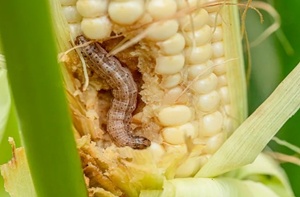
Fall army worm (FAW) (S. frugiperda, Lepidoptera: Noctuidae) is a highly polyphagous insect pest native to the Americas, attacking over 80 plant species including maize, sorghum and sugarcane (Prasanna et al., 2018; Prasoona et al., 2022). It was first reported in Africa in 2016 and has since spread across nearly all Sub-Saharan countries, causing significant yield losses, particularly in maize (FAO, 2017; Siazemo and Simfukwe, 2020). In Nigeria, the pest was first detected in Oyo and Ogun States and is now present nationwide (Georgen et al., 2016; Kamara et al., 2020). Uncontrolled infestations are estimated to cause annual maize losses of up to 8.3 – 20.6 million tons across major producing countries (Day et al., 2017).
Botanical pesticides have emerge as promising alternatives for FAW management. Extract from plants such as neem (Azadirachta indica), Chili, and black pepper (Piper guineense) have been reported with pesticidal effect against FAW and other pests (Kammo et al., 2019; Clovis et al., 2020). However, plants such as mahogany (Khaya senegalensis), and African bush tea (Hyptis suaveolens) were also reported with insecticidal effect against various agricultural pests (Kareru et al., 2013; Baidoo and Mochiah, 2016), but research on their efficacy against FAW remain limited. Furthermore, combining multiple botanicals may enhance effectiveness and sustainability in pest management, thus the need.
Methanol is widely used as an extraction solvent for plant-based bioactive compounds due to its high efficiency in isolating flavonoids, terpenoids, phenolics and alkaloids (Spingo et al., 2007; Carrera et al., 2012; Dieu-Hien et al., 2019). Its strong solubility and extraction yield make it particularly suitable for studies on botanical insecticides.
Materials and methods
Collection, preparation and extraction of plant materials
Matured Seeds of K. senegalensis, A. indica, and H. suaveolens were collected within Zaria environs, washed with clean water tap water, and shade-dried to complete dryness. Dried C. frutescens seeds were purchase from Zaria market. Each seed sample was separately ground into powder using a laboratory blender and stored until extraction.
Extraction was carried out in the Mycotoxicology Laboratory, Department of Crop Protection, ABU, Zaria, using cold maceration method with methanol as solvent. Two kilograms (2 kg) of each powdered sample were soaked in 6 L of methanol for 48 hours in a 12 L aspirator bottle. The filtrate obtained was concentrated using a rotary evaporator to yield a syrupy crude extract. Serial dilution of 100 ml of each extract were prepared using distilled water and 0.1% Tween 80 (as emulsifier, sticker, and suffocant) to obtain concentrations of 2.5%, 5.0% and 10.0% (w/v). The synthetic check, Emamectin benzoate (5% WDG), was prepared according to the manufacturer’s recommendation (10 g per 15 L of water).
Rearing of fall armyworm larvae
Larvae of S. frugiperda (sixth to seventh instar) were collected from maize fields at the Institute for Agricultural Research (IAR), Samaru, Zaria, and reared on an artificial diet in the Insectary, Department of Crop Protection, A.B.U. Zaria, until use for infestation.
Experimental site
The experiment was conducted at the Screen House, Department of Crop Protection, A.B.U. Samaru, Zaria, located at latitude 110 10’N and longitude 07038’E. The site falls within the Northern Guinea Savanna agro-ecological zone of Nigeria.
Treatments and experimental design
The treatments comprised three methanolic botanical extracts (Khaya, Hyptis, and Neem) and their mixtures (Khaya + Neem, Hyptis + Neem, and Khaya + Hyptis), each applied at a concentration of 2.5% (w/v). a standard check (Emamectin benzoate, 5% WDG) and untreated control were included, giving a total of eight treatments. The experiment was laid out in a Randomized Complete Block Design (RCBD) with four replications.
Experimental procedure
The maize variety used was SAMMAZ-17, a high-yielding, medium-maturing (90 – 100 days) cultivar tolerant to Striga. Purchased from the Institute for Agricultural Research (IAR), Samaru Zaria. Four seeds were sown per pot at a depth of 4 cm and later thinned to two seedlings after emergence. Compound fertilizer NPK (15:15:15) was applied at 120:60:60 kg ha-1 in two splits: half at planting and the remainder as urea (130 kg N ha-1) four weeks after sowing. All agronomic practices such as watering, weeding etc. were uniformly maintained.
Artificial infestation was done 21 days after emergence by introducing five neonate larvae per plant, placed at different leaf nodes to prevent cannibalism. Infestation was carried out early in the morning to avoid larval desiccation (Prasanna et al., 2018). Each plant pot was enclosed in a 2 m x 1 m x 0.5 m insect-proof cage to prevent larval movement between treatments (Kelita et al., 2020). Treatments were applied 10 hours after infestation, to allow the larvae settle down and established (Silva et al., 2018) using a hand-held sprayer to ensure uniform coverage. Applications were made weekly for three consecutive weeks.
Data collection
Data were collected on foliar damage incidence and severity, larval count, and dry matter yield.
Foliar damage incidence: The number of damaged leaves per plant was counted based on visible feeding symptoms and frass deposits. Percentage incidence was calculated using the formula:
Percent incidence = (Number of leaves damaged/Total number of leaves inspected) x 100
Foliar damage severity: leave damage severity was visually assessed using a modified scale of Davis and Williams (1992) as cited in Prasanna et al. (2018).
Larval count: the number of larvae present in the whorl and foliage of each plant was counted weekly.
Dry matter yield (DMY): plants were harvested at reproductive stage, air-dried, and weighted. The dry weight was recorded and converted to tons per hectare (t ha-1).
Data analysis
Data on insect count were square-root transformed prior to analysis. All data were subjected to Analysis of Variance (ANOVA) using R Studio. Treatment means were separated using the Student-Newman-Keuls (SNK) test at 5% level of significance.
Results
Effect of methanolic extract sprays of some botanicals and their mixtures on foliar damage incidence and severity and larval count of S. frugiperda on maize
The effects of methanolic botanical extracts and their mixtures on the foliar damage incidence, and severity and larval population of S. frugiperda under screen house conditions are presented in Table 1.
After first spay, treatments containing Hyptis + Neem, Neem alone, and the standard check (Emamectin benzoate) recorded significantly lower foliar damage incidence compared to the control. Although Khaya + Neem showed higher mean values, it remained statistically similar to Hyptis + Neem, and Neem. The control plots recorded the highest percentage incidence.
A similar trend was observed after second spray, were Hyptis + Neem, Neem alone, and the standard check maintained significantly lower foliar damage incidence, though not statistically different from Hyptis, Khaya + Hyptis, and Khaya + Neem. After the third spray, all botanical treatments and standard check recorded significantly lower foliar damage incidence compared to the control. Based on the overall means, all botanical treatments markedly reduced foliar damage incidence relative to the untreated control.
In terms of foliar damage severity score (LDSS), Hyptis + Neem and the standard check recorded the lowest mean values after the first and second sprays, though not statistically different from Neem and Khaya + Neem. All botanical treatments produced significantly lower LDSS than control after third spray. The combined means revealed that Hyptis, Khaya, and their mixtures were statistically similar, but differ significantly from the control, which had the highest severity rating.
For larval count, Hyptis + Neem, Neem and standard check consistently recorded significantly lower number of larvae across the sampling periods compared to the control. After the third spay, all treatments exhibited reduced larval populations, with Hyptis + Neem, Khaya + Neem and Neem showing comparable performance to the standard check. Overall means indicated that the botanical mixtures, particularly Hyptis + Neem and Khaya + Neem, significantly suppressed larval populations relative to the untreated control.
Effect of methanolic extract sprays of some botanicals and mixtures on maize dry matter weight
The effects of the methanolic botanical extracts and their mixtures on maize dry matter yield are presented in Table 2. Hyptis + Neem and standard check recorded the highest dry matter weight, which were statistically similar to Neem and Khaya + Neem. In contrast, the control treatment recorded the lowest yield, followed by Khaya and Hyptis singly, which were statistically at par with Khaya + Hyptis.
Overall, all botanical treatments significantly increased maize dry matter yield compared to the untreated control. The superior performance of the neem-based extracts and mixtures suggests enhanced plant protection and improved biomass accumulation resulting from reduced pest pressure.
Discussion
The results of this study revealed that methanolic extracts of Neem, Hyptis + Neem, and Khaya + Neem exhibited comparable efficacy to the standard check (Emamectin benzoate) in reducing foliar damage incidence and severity as well as larval population of S. frugiperda on maize. The observed effectiveness of neem and some of its mixtures, especially Hyptis + Neem could be attributed to their combined toxicity and antifeedant properties, as reported by (Mansur et al., 2023 unpublished).
These findings aligned with those of Birhanu et al. (2019), who reported a significant reduction in maize leaf damage and larval density following the application of botanical and synthetic insecticides, resulting in increased dry matter accumulation. Similarly, Kammo et al. (2019) found that neem oil extract effectively suppressed larval populations and minimized S. frugiperda infestation on maize.
The insecticidal potential of H. suaveolens against lepidopteran pests has been documented (Prakash et al., 2008). Cyrille et al. (2011) reported that H. suaveolens extracts reduced feeding activity of several lepidopteran pests, including Sesamia calamistis (Hampson) and Spodoptera Litura (Boisduval). Similarly, Ignacimuthu and Jayaraj (2003) and Jayakumar et al. (2004), observed that extracts of H. suaveolens effectively suppressed populations of Aphis craccivora and Callosobruchus maculatus on groundnut and cowpea, respectively. The present study therefore confirms the bioactivity of H. suaveolens against S. frugiperda, supporting its potential use in maize pest management.
The enhanced efficacy observed in botanical mixtures such as Hyptis + Neem and Khaya + Neem may be due to synergistic interactions among their active compounds, leading to broader insecticidal activity. This observation corroborates Oparaeke et al. (2005), who found that combinations of neem with other botanicals such as lemongrass, bitter leaf, and tomato significantly reduced damage by Maruca vitrata and Clavigralla tomentosicollis on cowpea and increased grain yield. Likewise, Bulus et al. (2023) reported nematicidal activity of Hyptis + Neem mixtures that inhibited egg hatching of Meloidogyne spp., suggesting that such combinations can enhanced pest control efficiency.
Overall, the findings from this study underscore the effectiveness of neem and its combinations with Hyptis and Khaya in suppressing fall armyworm infestation. Their comparable performance with the standard synthetic insecticide suggests their potential as eco-friendly components in Integrated Pest Management (IPM) programs.
Conclusion
The findings from this study clearly demonstrate that methanolic extracts of A. indica and its mixtures with H. suaveolens and K. senegalensis, were highly effective in reducing the incidence, severity and larval population of S. frugiperda on maize under screen house conditions. These treatments also resulted in significantly higher dry matter yield (3.25, 3.85, and 2.95 t ha-1, respectively), which were statistically comparable to the standard chemical check (3.90 t ha-1).
The enhanced performance of neem-based mixtures suggests synergistic effects among their bioactive compounds, making them promising alternatives to conventional insecticides. Given their efficacy, safety, and potential compatibility with other pest control methods, these botanicals, can serve as vital components of an Integrated Pest Management (IMP) strategy against fall armyworm infestation in maize.
However, as this study was conducted under screen house conditions, further field evaluations are recommended to validate these results under natural environmental conditions and to assess the persistence, mode of action, and potential effects on non-target organisms.
References
Baidoo P.K., Mochiah M.B. (2016). Comparing the effectiveness of garlic (Allium sativum L.) and hot pepper (Capsicum frutescens L.) in the management of the major pests of cabbage Brassica oleracea (L.). Sustainable Agriculture Research, 5: 83-91.
Birhanu S., Tadele T., Mulatu W., Gashawbeza A., Esayas M. (2019). The Efficacy of Selected Synthetic Insecticides and Botanicals against Fall Armyworm, Spodoptera frugiperda, in Maize. Insects, 10: 45.
Bulus J., Kwanashie A.J., Utono I.M., Habila J.D., Alao S.E.L., Zarafi A.B., Bamaiyi L.J., Abubakar A., Kashina B.D. (2023). In vitro ovicidal activity of bio-pesticidal compounds on Meloidogyne incognita eggs. Nigerian Society of Nematologists (NISON) 6th Biennial Conference Abuja October, 2023.
Carrera C., Ruiz-Rodriguez A., Palma M., Barroso C.G. (2012). Ultrasound assisted extraction of phenolic compounds from grapes. Analytica Chimica Acta, 732: 100-104.
Clovis B.T., Raymond N.N., Justin N.O., Aaron S.T., Christopher N. (2020). Effect of intercropping beans with maize and botanical extract on fall armyworm (Spodoptera frugiperda) Infestation. International Journal of Agronomy, 2020: 4618190, 7 pages.
Cyrille A., Pierre A., Kerstin H., Manuele T. (2011). Potential use of the Bush mint Hyptis suaveolens, for the control of infestation by the pink stalk borer, Sesamia calam istis on maize in Southern Benin, West Africa. Journal of Insect Science, 11: 1-13.
Day R., Abrahams P., Bateman M., Beale T., Clottey V., Cock M., Witt A. (2017). Fall Armyworm: Impacts and Implications for Africa. Outlooks on pest management, 28: 196-201.
Dieu-Hien T., Dinh H.N., Nhat T.A.T., Anh T., Anh V.B., Tuong H.D., Hoangg C.N. (2019). Evaluation of the use of different solvents for phytochemical constituents, antioxidants, and in vitro anti-inflammatory activities of Severinia buxifolia. Journal of Food Quality, 2019: 8178294.
FAO (2017). Fall Armyworm outbreak, a blow to prospects of recovery for southern Africa. Rome, Italy.
Goergen G., Kumar P.L., Sankung S.B., Togola A., Tamò M., (2016). First report of outbreaks of the fall armyworm Spodoptera frugiperda (J.E. Smith) (Lepidoptera, Noctuidae), a new alien invasive pest in West and Central Africa. PLoS One, 11: e0165632.
Ignacimuthu S., Jayaraj S. (2003). Eco-friendly approaches for sustainable insect pest management. Current Science, 84: 1292-1293.
Jayakumar M., Elumalai K., Jeyasankar A., Raja N., Ignacimuthu S. (2004). Biological activity of H. suaveolence Poit (Lamiaceae) and Melochia Chorcorifolia (Sterculiaceae) on cowpea weevil, Callosobruchus maculatus (F.) (Coleoptera: Bruchidae). Journal of Entomological Research, 29: 265-269.
Kamara A.Y., Kamai N., Omoigui L.O., Togola A., Ekeleme F., Onyibe J.E. (2020). Guide to maize production in northern Nigeria: lbadan, Nigeria.
Kammo E. Q., Suh C., Mbong G.A., H.djomo S., chimi N.L.L., Mbeungang D-L., Mafouasson H., Meseka S., Menkir A. (2019). Biological versus chemical control of fall armyworm and lepidoptera stem borers of maize (Zea mays). Agronomie Africaine, 31: 187–198.
Kareru P., Rotich Z.K., Maina E.W. (2013). Use of botanicals and safer insecticides designed in controlling insects: The African Case. Intechopen.
Kelita P., Yolice T., Trust K., Vernon H.K., Philip C.S., Steven R. B. (2020). Bioactivity of common pesticidal plants on fall armyworm larvae (Spodoptera frugiperda). Plants, 9: 112.
Oparaeke A.M., Dike M.C. Amatobi C.I. (2005). Botanical pesticide mixtures for insect pest management on cowpea, Vigina unguiculata (L.) Walp Plants. The pod borer Maruca vitrata Fab. (Lepidoptera: Pyralidae) and pod sucking bug, Claigralla tomentosicollis Stal (Heteroptera: Coreidae). Agricultura Tropica et Subtropica, 28: 33-38.
Parakash A., Jagadiswari R., Nandogopal V. (2008). Future of botanical pesticides in rice, wheat, pulses and vegetables pest management. Journal of Biopesticides, 1: 154-169.
Prasanna B.M., Joseph E.H., Regina E., Virginia M.P. (eds) (2018). Fall Armyworm in Africa: A Guide for Integrated Pest Management, First Edition. Mexico, CDMX: CIMMYT.
Prasoona U.S., Kolhe A.V., Tathode V.R., Tidke V.N. (2022). Antifeedant activity of some botanicals against Spodoptera frugiperda (J.E. Smith) under laboratory condition. The Pharma Innovation Journal, 11: 101-104.
Siazemo M., Simfukwe P. (2020). An evaluation of the efficacy of botanical pesticides for fall armyworm control in maize production. Open Access Library Journal, 7: 1-12.
Silva G.A., Picanço M.C., Ferreira L.R., Ferreira D.O., Farias E.S., Souza T.C., Pereira E.J.G. (2018). Yield losses in transgenic Cry1Ab and non-Bt corn as assessed using a crop-life-table approach. Journal of Economic Entomology, 111: 218–226.
Spigno G., Tramelli L., De Faveri D.M. (2007). Effects of extraction time, temperature and solvent on concentration and antioxidant activity of grape marc phenolics. Journal of Food Engineering, 81: 200-208.