Abstract
Food insecurity continues to challenge rural households despite the adoption of various adaptation strategies. Climate-Smart Agricultural Practices (CSAP) have emerged as viable tools to mitigate climate impacts and improve food security among smallholder farmers. This study assessed the socio-economic characteristics of smallholder millet farmers, examined the effect of CSAPs on household food security, and identified challenges faced by farmers in Jigawa State, Nigeria. A multi-stage sampling technique was used to select 262 respondents across the four Agricultural Development Programme (ADP) zones. Data were collected using structured questionnaires and analysed using descriptive statistics and binary logistic regression. Results showed that the majority (71.8%) of farmers were medium users of CSAPs, while 25.6% were high users. About 46.2% of households were food secure, while 53.8% were food insecure. Binary logistic regression indicated that cover cropping, improved disease-resistant varieties, farm size, and extension visits significantly influenced food security, while ridging and early planting had negative effects. Challenges identified included inadequate access to inputs, credit, irrigation, and extension services. The study recommends increased access to improved inputs, strengthening of extension services, and policy interventions to improve food security.
Keywords: Climate-Smart Agriculture, Millet, Food Security, Smallholder Farmers, Jigawa State
INTRODUCTION
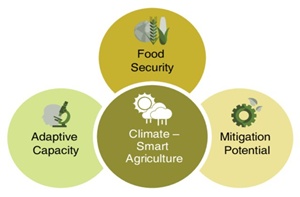
Agriculture remains central to food security, especially in developing nations like Nigeria, where over 70% of the population engages in small-scale farming (FAO, 2021). In Jigawa State, agriculture contributes substantially to household income, employment, and food availability. However, climate variability has made agricultural production more precarious, particularly for resource-poor smallholder farmers (Adelekan et al., 2021). Rising temperatures, delayed and erratic rainfall, droughts, and floods reduce millet productivity, making it difficult for farmers to maintain stable food supplies (IPCC, 2014; World Bank, 2022). Millet (Pennisetum glaucum), known for its drought tolerance, is a staple in Jigawa State. Despite its resilience, millet yields have dropped in recent years due to extreme weather events, soil degradation, pest outbreaks, and a general lack of technological inputs (Ismaila et al., 2020; Obi et al., 2020). These challenges necessitate the adoption of sustainable and climate-resilient practices. Climate-Smart Agriculture (CSA) offers an integrated approach to achieving food security under climate change. According to the FAO (2013), CSA aims to sustainably increase productivity, enhance resilience (adaptation), and reduce greenhouse gas emissions. Climate-Smart Agricultural Practices (CSAPs) include improved crop varieties, conservation tillage, agroforestry, integrated pest management, organic manure application, crop rotation, and efficient water use techniques (Lipper et al., 2019; Oyawole et al., 2020). Theoretical frameworks such as the Household Food Security Framework (HFSF) provide a useful guide in understanding how practices like CSAPs influence food access, availability, utilization, and stability (USAID, 1999). These four pillars help in evaluating food security outcomes resulting from CSA interventions. While there is growing awareness of CSA, empirical data on its adoption and its direct impact on food security especially among millet farmers in Jigawa State remains limited. Additionally, the extent to which socioeconomic characteristics influence adoption and how farmers navigate the challenges to CSA implementation are not adequately documented. This study aims to bridge that gap.
Objectives of the Study
The main objective of the study was to determine the effect of using Climate-Smart Agricultural Practices on the food security status of smallholder millet farming households in Jigawa State, Nigeria, while the specific objectives are to:
• Describe the socioeconomic characteristics of smallholder millet farmers in the study area.
• Determine the effect of using Climate-Smart Agricultural Practices on the food security status of smallholder millet farmers.
• Identify the challenges smallholder millet farmers face in achieving the full benefits of Climate-Smart Agricultural Practices.
METHODOLOGY
Study Area
Jigawa State is located in the semi-arid region of northern Nigeria, between latitudes 11°N and 13°N and longitudes 8°E and 10°E. It shares borders with Kano, Katsina, Bauchi, and Yobe States. The climate is characterized by a short rainy season (June to September) and a prolonged dry season. The average annual rainfall ranges between 600 mm and 1000 mm. Agriculture is the main occupation, with millet, sorghum, maize, and rice being the dominant crops. The state is divided into four ADP zones: Birnin Kudu, Gumel, Hadejia, and Dutse.
Sampling Procedure and Sample Size
A multi-stage sampling technique was used to select respondents. In the first stage, four ADP zones in Jigawa State were purposively selected due to their intensive millet cultivation. In the In the second stage, two LGAs were randomly selected. Finally stage involves, random sampling of smallholder millet farmers was drawn from each LGA using proportionate sampling based on the population size of millet farmers. A total of 262 respondents were sampled.
Data Collection
Primary data were obtained using a structured questionnaire. The questionnaire captured data on socioeconomic characteristics, usage of CSAPs, food security status (via HFIAS), and perceived constraints to CSAP implementation. The HFIAS contains nine occurrence questions and corresponding frequency of occurrence questions, allowing classification of households as food secure or insecure based on a cumulative score.
Analytical Tools
Descriptive statistics (frequency, percentage, mean, and standard deviation) were used to analyze socioeconomic characteristics and constraints.
Binary logistic regression was employed to determine the effect of CSAPs on food security.
Model Specification
The binary logistic regression model is specified as follows:
Where:
Logit (P) is the log-odds of being food secure.
P(Y=1) is the probability of being food secure (Y = 1).
1- P(Y=0) is the probability of being food insecure (Y = 0).
β0: Intercept (constant term).
X1, X2….. Xk These represent the independent variables, which are the frequencies of the Climate-Smart Agricultural Practices (CSAPs) used by the farmers.
β1, β2….. βk: Coefficients for each CSAP, representing the effect of each practice’s frequency on the odds of being food secure.
γ1,γ2… γk: Coefficients for the control variables.
Z1, Z2… Zk: These represent the control variables (e.g., socioeconomic variables such as age, gender, income, farm size, education).
X1-13= Climate Smart Agriculture practices: Each CSAP will be treated as an ordinal variable (based on the frequency of use).
RESULTS AND DISCUSSION
The result in Table 1 shows that a majority (43.9%) of the smallholder millet farmers were in the age bracket of 33–47 years, with a mean age of 41 years. This suggests that millet farming in the study area is largely dominated by economically active individuals, capable of exploring innovations and engaging in physically demanding agricultural practices. This finding is in line with Ojoko (2021), Salisu (2022), and Orifah et al. (2024), who also found that younger and middle-aged farmers were more likely to adopt climate-smart agricultural (CSA) practices. Also, Table 1 shows that all (100%) of the respondents were male, indicating that millet production in Jigawa State is male-dominated. This trend is likely influenced by cultural and religious norms that define agricultural roles along gender lines. Similar gender patterns in agricultural labour were observed by Ojoko (2021) and Orifah et al. (2024), emphasizing that female farmers often face barriers in accessing land and CSA technologies.
In terms of marital status, the result reveals that most respondents (71.0%) were married. Married individuals may be more inclined to adopt CSA practices to ensure food security for their households. This supports earlier findings by Ojoko (2021) and Orifah et al. (2024) that married farmers were more proactive in embracing innovations due to family responsibilities. The educational status of the respondents indicates that a majority (59.9%) had received formal education, while 40.1% had only informal education. Education enhances a farmer’s capacity to access and interpret climate information and technologies. This finding aligns with Bello et al. (2018) and Orifah et al. (2024), who both emphasized the role of literacy in facilitating CSA adoption.
Regarding household size, most respondents (35.1%) had 6–10 household members, with a mean size of 8. This suggests access to family labour, which is vital for managing labour-intensive CSA practices. This observation is consistent with the findings of Njuguna et al. (2015) and Atube et al. (2021), who noted the importance of household size as a source of on-farm labour.
The result in Table 2 shows that farm sizes are generally small, with 71.8% cultivating between 0.5–1.5 hectares of millet, and a mean millet farm size of 1.07 hectares. This supports Orifah et al. (2024) and Ojoko (2021), who both reported limited land holdings as a key constraint in adopting land-intensive CSA techniques. In terms of income, the majority (37.4%) earned ₦468,750 – ₦907,499 annually from all sources, while 72.9% earned ₦30,000 – ₦468,749 from millet farming. The mean incomes were ₦790,717 (total) and ₦384,656 (millet-specific), with wide variability (high SD). These findings echo Anamayi and Anamayi (2024) and Orifah et al. (2024), who described smallholder farmers as low-income earners with limited capital for CSA investment. The result also shows that 68.7% of farmers belonged to a farmer organization. Membership in farmer groups is known to improve access to training and collective bargaining power, enhancing CSA adoption as reported by Adebisi et al. (2022).
Credit access remains a challenge: only 65.3% had access to credit, and most (63.0%) relied on informal sources such as friends and relatives. This highlights the continued exclusion of smallholder farmers from formal financial systems, limiting their ability to finance CSA inputs, as also found in Ojoko (2021). Finally, the results show a significant gap in extension services: while 51.9% had some access to extension visits, 48.1% had none. Only 24.4% received occasional visits. Lack of frequent and structured extension contact limits knowledge transfer and CSA dissemination. These findings are supported by Orifah et al. (2024) and Adebisi et al. (2022).
Effect of CSAPs on Food Security
The result in Table 3 shows that the model chi-square is statistically significant at 1%, indicating that the predictors jointly explain variations in household food security status. The model had a good fit, with a Nagelkerke R² of 0.615 and a prediction accuracy of 81.3%. Among the CSAP variables, use of ridges (β = -2.139, p = 0.000), cover cropping (β = 0.732, p = 0.004), improved disease-resistant varieties (β = 0.825, p = 0.047), and early planting (β = -0.702, p = 0.043) significantly influenced food security. The negative coefficient for ridges implies reduced likelihood of food security among adopters, possibly due to poor design or soil incompatibility. Cover cropping and disease-resistant varieties had positive coefficients, suggesting they enhance food availability. Early planting, despite being a recommended CSAP, had a negative effect, likely due to rainfall timing mismatch.
Drought-resistant varieties were marginally significant (β = -0.499, p = 0.097), indicating possible issues with seed quality or agronomic fit. Among socio-economic variables, farm size for millet production (β = 0.955, p = 0.024), total income (β ≈ 0.000, p = 0.000), millet income (β ≈ 0.000, p = 0.009), and extension visit (β = -0.886, p = 0.048) significantly influenced food security. The positive coefficients imply that larger farm size and higher income increase food security, while poor access to extension services reduces it. This reinforces the argument by Lipper et al. (2019) and Harvey et al. (2020) that CSAPs, when properly implemented, improve food access and resilience. Poor results from ridging and early planting may reflect poor agro-advisory timing.
Challenges faced by smallholder millet farmer’s in achieving the full benefits of climate-smart agricultural practices
The result in Table 4 reveals that insufficient farm credit (mean = 2.47) is the most critical constraint limiting smallholder millet farmers from maximizing the benefits of CSAPs. This supports Salisu (2022) and Mailumo et al. (2021), who identified access to affordable credit as a persistent challenge among Northern Nigerian farmers. The high cost of inputs (mean = 2.41) ranked second, aligning with Mailumo et al. (2021) and Munz and Schuele (2022), who emphasized that input inflation discourages adoption of climate-smart innovations. Inadequate access to improved technology (mean = 2.39) and limited farm equipment (mean = 2.21) were also major constraints, corroborating findings by Nonvide (2021), Salisu (2022), and Orkaa and Ayanwale (2021). Environmental challenges (mean = 2.11), including erratic rainfall and soil degradation, further constrain uptake, as also noted by Dunjana et al. (2023).
Other key limitations include poor access to extension services (mean = 2.04), inadequate capital (mean = 2.03), and lack of credit access (mean = 2.02), reflecting broader institutional and systemic gaps. Sociocultural and policy barriers such as lack of training (mean = 1.73) and weak policy support (mean = 1.66) were also reported. Labour-related issues like high cost (mean = 1.64) and labour intensity (mean = 1.37) remain challenges during peak periods. Postharvest losses (mean = 1.14) and market constraints (mean = 0.76) were ranked lowest among the listed challenges.
CONCLUSION
The study concludes that climate-smart agricultural practices (CSAPs) such as cover cropping, improved millet varieties, and organic soil fertility management contributed positively to food security among smallholder millet farmers in Jigawa State. However, certain practices like early planting and ridging negatively affected food outcomes, highlighting the importance of context-specific application. The binary logistic regression revealed that farm size, income from millet, total household income, and access to extension services significantly influenced household food security. Despite moderate CSAP adoption, some of the households remained food insecure due to constraints such as limited access to credit, poor extension contact, and inadequate training and inputs.
Based on the findings of the study, the following recommendations were made:
• Farmers should be encouraged to adopt climate-smart agricultural practices (CSAPs) that have proven to improve food security, such as cover cropping and the use of improved millet varieties, while discouraging poorly performing ones like early planting and ridging through targeted awareness.
• The Ministry of Agriculture, in partnership with NGOs and extension agencies, should strengthen training programs and demonstration plots to improve farmers’ technical knowledge and promote effective CSAP implementation.
• Government and stakeholders should work towards improving farmers’ access to credit and subsidized farm inputs such as improved seeds, organic fertilizers, and bio-pesticides to reduce financial constraints to CSAP adoption.
• Farmer cooperatives should be supported and strengthened to enable collective access to loans, market opportunities, and technical support that enhance group-based adoption of CSAPs.
• Agricultural research and extension services should tailor CSAP recommendations to suit the agro-ecological realities of different communities, ensuring practices align with local climatic conditions.
• Efforts should be made to introduce off-farm income-generating activities such as agro-processing and rural trade to improve household economic resilience and support long-term CSAP investment.
REFERENCES
Adelekan I.O., Abiodun B.J., Ajayi V. O. (2021). Climate risks and adaptation strategies in West Africa. Journal of Climate Resilience, 15: 112–128.
Ani A.O., Ibrahim M., Ahmed A. (2022). Climate variability and food insecurity in northern Nigeria. African Journal of Agricultural Economics, 9: 88–97.
FAO (2013). Climate-Smart Agriculture Sourcebook. Rome: Food and Agriculture Organization of the United Nations. Retrieved from https://www.fao.org/climate-smart-agriculture-sourcebook
FAO (2021). The State of Food Security and Nutrition in the World 2021. Rome: FAO. Retrieved from https://www.fao.org/3/cb4474en/cb4474en.pdf
Harvey C.A., Rakotobe Z.L., Rao N.S., Dave R., Razafimahatratra H., Rabarijohn R.H., Rajaofara H., MacKinnon J.L. (2020). Climate-smart agriculture and smallholder livelihoods: A review. Agricultural Systems, 180: 102763.
IPCC (2014). Climate Change 2014: Impacts, Adaptation, and Vulnerability. Part A: Global and Sectoral Aspects. Contribution of Working Group II to the Fifth Assessment Report of the Intergovernmental Panel on Climate Change. Cambridge University Press.
Ismaila U., Gana A.S., Tswanya N.M., Dogon-Daji S.D. (2020). Trends in millet production and constraints in Nigeria. Journal of Agricultural Extension, 24: 13–21.
Lipper L., Thornton P., Campbell B.M., Baedeker T., Braimoh A., Bwalya M., Caron P., Cattaneo A., Garrity D., Henry K., Hottle R., Jackson L., Jarvis A., Kossam F., Mann W., McCarthy N., Meybeck A., Neufeldt H., Remington T., Vermeulen S.J. (2019). Climate-smart agriculture for food security. Nature Climate Change, 4: 1068–1072.
Munz M., Schuele H. (2022). Infrastructure constraints in smart agriculture: Lessons from sub-Saharan Africa. Sustainable Agriculture Review, 28: 215–234.
Obi M., Adebayo S.A., Musa S. (2020). Challenges of millet farming in semi-arid Nigeria. Agricultural Science Digest, 40: 61–67.
Orifah J.A., Musa I., Ibrahim M. (2024). Analysis of Climate-Smart Agriculture and Food Security among Rice Farmers in Dutse, Jigawa State. Journal of Sustainable Agriculture and Extension, 12: 35–52.
Orkaa A., Ayanwale A.B. (2021). Institutional barriers to adoption of smart farming technologies in Nigeria. International Journal of Agricultural Policy, 17: 119–129.
Oyawole F.P., Sulaiman J., Musa M.A. (2020). Climate-smart agriculture adoption and its effect on productivity of smallholder farmers in Nigeria. African Journal of Agricultural Research, 15: 532–540.
USAID (1999). Household Food Security Conceptual Framework. Washington, D.C.: United States Agency for International Development.
World Bank (2022). Nigeria Food Security Brief. Washington D.C.: World Bank. Retrieved from https://www.worldbank.org.