Abstract
This study was carried out to evaluated the quality attributes of broiler Kilishi, produced from fresh meat of three avian species: broiler chicken, duck, and turkey. The research aimed to compare the Kilishi for chemical characteristics. The Kilishi samples were prepared using fresh cuts of 5 kg from the three avian species, marinated with spices and groundnut cake, sun-dried for 6 hours and later roasted for two hours for each sample. The prepared samples were analysed for their nutritional profiles. The results showed that there were significant differences in the nutritional composition of the Kilishi made from the three avian spices. Turkey Kilishi (TK) had the highest protein content (66.2 g/100g), while Duck Kilishi (DK) exhibited the highest fat (10.2 g/100g) and ash content (15.3 g/100g). TK had the highest moisture content (9.75 g/100g). Results of mineral analysis revealed that TK had the highest calcium content (83.5 mg/100g), while DK had the highest phosphorus and magnesium levels (1698 mg/100g and 208.7 mg/100g, respectively). Fatty acid analysis indicated that DK had the highest saturated fatty acid (43.4 g/100g), while Chicken Kilishi (CK) exhibited higher levels of polyunsaturated fatty acids (4.41g/100g). The vitamin composition showed CK had the highest niacin (16.8 mg/100g) and vitamin A (21.0 IU), while DK had the highest choline content (92.7 mg/100g). The essential amino acid profile revealed that CK had the highest leucine (6.01g /100g) and lysine (4.19 g/100g) content. The findings provide an insights into poultry Kilishi production, with potential benefits for poultry producers, processors and consumers.
Keywords: Kilishi, Chicken, Duck, Turkey, Polyunsaturated fatty acid, Marinates, Nigeria
INTRODUCTION
Meat is an edible part of animals that comprised principally of fat, muscle, connecting tissues and used as food (Iheagwara and Okonkwo, 2016). According to Hui et al. (2001) meat is an edible post mortem component originating from live animals. The authors further stated that it is the whole or part of the carcass of animals such as buffalo, camel, cattle, goat, pig, poultry, rabbit and sheep slaughtered other than in a wild state, and intended for human consumption. Beef generally refers to the meat of a heifer, cow, bull, young bull, bullock and steer (Emokaro and Amadasun, 2012). Meat is one of the most popular and nutritious food items which come from flesh of animals that are suitable as food (Forrest et al., 2001). Meat is rich in quality protein, significant amount of minerals, appreciable essential vitamins as well as enough fat for energy production (Ahmad et al., 2018). Meat preservation is highly sophisticated that requires reliable and constant power supply that is only found in developed countries. This implies that in developing countries, there is need for appropriate technologies that are affordable, simple and applicable that suit the local environment in terms of social and economic conditions (Ogunsola and Omojola, 2008).
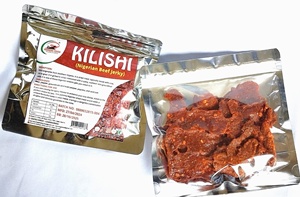
Kilishi is one of the processed meat products that is highly marinated with spices and liquid groundnut cake mixture (Mgbemere et al., 2011). Kilishi is prepared by partially drying thin sheets of lean beef in the sun followed by addition of some ingredients before a second period of sun drying and then partial roasting (Igene et al., 1990; Musonge and Njolai, 1994). Kilishi is a processed meat product that is made using lean beef meat type that has an intermediate moisture content with varying constituents of protein, moisture, lipid, fibre and ash although it depends on the quantity of meat used (Mgbemere et al., 2011), The development of an ingredient-mix dried Poultry snack (kilishi) with high nutritional value would greatly limit consumer dependence on beef. The in-depth understanding of the optimum processing technique for producing a poultry kilishi would aid in the development of a functional product with a high nutritional composition that can improve the health of the consumers (Mayowa et al., 2022).
MATERIAL AND METHODS
The experiment was conducted at Livestock Teaching and Research Farm, Department of Animal Science Federal University Dutsin-Ma, Katsina State. The farm is situated within the latitude 12027’ 18’ North and 7029’29’ East and 605 meters above sea level with an annual rainfall of 700 mm and situated in the Sudan Savannah ecological zone (Abaje et al., 2012; Tukur et al., 2013).
Experimental materials
Ingredients; spices, black pepper, clove, alligator pepper, hot pepper, sweet pepper, onion, ginger, garlic African nutmeg, were purchased at local market in Katsina, Katsina State. Likewise, ingredients like salt, sugar, maggi seasoning were also purchased at local market. De-fatted groundnut cake and water were purchased from local groundnut cake processor and water vendor respectively (Table 1). Digital weighing scale, sharp knife, corn stalk bed, wire mesh was also used for weighing, meat trimming and spreading of sliced meat respectively.
Meat preparations
Fresh meat from breast and drumstick of each of the three avian species were used for this study. The meat was trimmed free of fat and excess connective tissues. Fresh meat obtained from these avian species were cut into smaller portions of about 150 – 200 g and cut into very thin slices in continuous sheet. The pieces of sliced meat were then thinly spread on silver trays and sun dried for 8 hours. The dried pieces were kept in airtight containers for the next processing step (Muhammad and Muhammad, 2007; Ogunsola and Omojola, 2008).
Preparation of infusing slurry
The method described by Iheagwara and Okonkwo (2016) was adopted with slight modifications. Each spice was ground into powder using a blender. Onions were sliced into small thin cubes. De-fatted groundnut cake, water and salt were also used. All the infusing ingredients were measured using digital scale and were mixed up thoroughly to achieve an even distribution. The thoroughly mixed ingredients were poured into water and stirred.
Kilishi preparation
The pieces of dried meat were soaked in the slurry prepared for an hour, after which they were removed and carefully spread out one by one on trays. A closed space mosquito net was thinly spread over the closely touching trays to keep off houseflies from perching on the meat slices, then left to dry for 5 hrs. After 5 hours, the infused meat slices were slightly roasted for 5 minutes to heat-seal the ingredient in the product. After cooling in the tray, the products were packaged. The digital weighing scale was used in the weight of the prepared kilishi.
Experimental design
Completely randomised design (CRD) was used in this study, in which meats from the matured male chicken, duck and turkey, were used for this study.
RESULTS AND DISCUSSION
Chemical composition of kilishi produced from three avian species
The Nutritional composition of the kilishi made from the three avian species (chicken, duck and turkey) are presented in Table 2. The species from the produced Kilishi affected all the proximate parameters evaluated.
Results showed that moisture content was significantly different among the three avian species. The moisture content of the jerky (kilishi) ranged from 8.69 g/100 g to 9.75 g/100 g with TK having the highest moisture content of 9.75 g/100 g and CK having the lowest moisture content of 8.6 g/100 g. This difference may be attributed to the different meat type used in the kilishi production. However, USDA (2006) reported higher moisture content of chicken, turkey and duck, 74.4 g/100 g, 72.5 g/100 g and 70.8 g/100 g, respectively. This contradicted the finding of this research owing to the fact that it is kilishi not a fresh meat. The reduction in moisture content of CK is desirable as this can affect the quality of the sample positively in relation to other kilishi samples (Apata et al., 2013).
There was significant difference in the protein content of the kilishi type. The protein content of the jerky (kilishi) ranged from 65.1 g/100 g in DK to 66.2 g/100 g in TK with TK having the highest value of 66.2 g/100 g. This difference may not be unconnected with the meat type as well. TK had the highest value of 66.2 g/100 g while DK had the lowest of 65.1 g/100 g. USDA (2006) reported a protein content of chicken, turkey and duck meat as 12.1 g/100 g, 13.7 g/100 g, 12.8 g/100 g respectively. The difference between the finding of this research may be due to condiment used as coating material.
The ash content of the jerky (kilishi) evaluated ranged from 14.3 g/100 g in TK to 15.3 g/100 g in DK and it differed significantly. DK had the highest value of 15.3 g/100 g while TK had the lowest value of 14.3 g/100 g which may be attributed to the meat type used in the preparation of Kilishi. The ash content of chicken, turkey and duck is 1.0 g/100 g, 0.8 g/100 g and 1.2 g/100 g respectively (USDA, 2006). The aforementioned results contradicted the finding of this research due to condiments used in the preparation of kilishi which also contain ashes. The Ash content is an indicator of the mineral content of the meat.
The fat content of the jerky (kilishi) differed significantly and ranged from 9.35 g/100 g to 10.2 g/100 g. DK had the highest value. The differences may be attributed to the species used in the kilishi production, animal age and management. The fat content of chicken is 11.1 g/100 g, turkey is 11.9 g/100 g and duck is 13.8 g/100 g (USDA, 2006). This corroborated the finding of this research that duck meat had higher fat but the difference in value may be due to the condiment used in the kilishi production.
The mineral compositions of kilishi made from the three avian species (chicken, duck and turkey) are presented in Table 3 Results show significant differences among the parameters evaluated with the exception of zinc in which kilishi type showed non- significantly differences.
Results showed significant difference in the mineral contents of the kilishi prepared from the three avian species. The content of calcium ranged from 70.6 mg/100 g to 83.5 mg/100 g, with TK having the highest value (83.5) and the least was obtained from DK (70.6). The calcium content of chicken kilishi is 29.6 mg/100 g as reported by Emmanuel et al. (2020). It was lower than the value obtained in this study. The significant differences among the parameters evaluated may be due to the type of meat used for the kilishi production which significantly influenced the calcium content of the kilishi. Values obtained for the variety of kilishi in this study were higher than what was reported by Muhammad et al. (2010), who obtained 2.46 mg/g in camel kilishi and Ndife et al. (2022), who reported 46.1 mg/100 g. The variations may be due to the differences in species used for the production of the kilishi.
Phosphorus content of the kilishi produced from the avian species showed significant differences. Phosphorus content obtained from the samples ranged from 1525 mg/100 g to 1698 mg/100 g, with the highest value recorded in DK (1698) while the lowest was obtained in TK (1525). The variations observed may not be unconnected with the meat type. Emmanuel et al. (2020) reported 781 mg/100 g of Phosphorus in beef jerky which is lower than the findings of this research.
There were significant differences in magnesium content among the kilishi from the three avian species. Magnesium content obtained from the jerky (kilishi) ranged from 177 mg/100 g to 209 mg/100 g. The highest value of 209 was obtained in DK while the lowest was value recorded in TK (177). The findings of this research was higher than 26.5 mg/100 g reported by Ndife et al. (2022) and 7.88 mg/g reported by Muhammad et al. (2010) in camel kilishi while Emmanuel et al. (2020) reported 81.6 mg/100 g in beef kilishi. The difference may be due to the difference in species used for the production of the kilishi. Magnesium is an essential component of all cells and is necessary for the functioning of enzymes involved in energy utilization and it is present in the bone (Ayodele et al., 2019).
The potassium content obtained from the jerky (kilishi) ranged from 2085 mg/100 g to 2451 mg/100 g. CK had the highest value of 2451 mg/100 g while DK had the least value of 2085 mg/100 g. There were significant differences among the evaluated parameters signifying the meat type used for the kilishi preparation. Emmanuel et al. (2020) reported 985 g/100 g in beef kilishi which contradicted the findings of this research. Camel kilishi is reported to have had 10.1 mg/g of potassium (Muhammad et al., 2010). The difference may be due to the difference in species used for the production of the kilishi.
The content of sodium obtained from the jerky (kilishi) ranged from 249 mg/100 g to 280 mg/100 g. CK had the highest value among the three parameters. There were significant differences among evaluated parameters which may connected with the different meat type used for the production of the kilishi. Ndife et al. (2022) reported 31.7 mg/100 g of Sodium in chicken kilishi which was lower than the finding (280 mg/100 g) of this research. Muhammad et al. (2010) reported 3.85 mg/g of sodium in beef kilishi which slightly differ with 320 g/100 g of sodium reported by Emmanuel et al. (2020). Sodium regulates the water content of the body, as well as aiding in transporting CO2 and maintains osmotic pressure of bodily fluids (Ahmad et al., 2018). The low sodium content might be beneficial since a low sodium diet has been reported to be beneficial in the prevention of high blood pressure (Ogunsola and Omojola, 2008).
Iron content obtained from jerky (kilishi) ranged from 15.3 mg/100 g to 16.3 mg/100 g and highest value was obtained from CK. There were significant differences among the evaluated parameters signifying difference in avian species used in the production of the Kilishi. Ndife et al. (2022) reported 2.06 mg/100 g of iron in Chicken kilishi while Muhammad et al. (2010) found 1.67 mg/g of iron in camel kilishi. Emmanuel et al. (2020) reported 8.62 mg/100 g of iron in beef kilishi which differ with the findings of Muhammad et al. (2010) which was 1.51 mg/g. Iron is required for the synthesis of haemoglobin and myoglobin, which are oxygen carriers in the blood and muscle respectively (Mirade et al., 2020). The recommended daily allowance of iron ranged from 8-18 mg /100 g as stated by Yang et al. (2009) implying that all three parameters are good source of iron. The zinc content obtained from the result showed there was non-significant difference among the kilishi type evaluated. Values observed ranged from 16.5 mg/100 g to 17.3 mg/100 g with the CK having the highest value among the parameters evaluated.
CONCLUSION
This study evaluated the quality attributes of Kilishi produced from chicken, duck, and turkey meat, focusing on nutritional, mineral, and fatty acid composition. The results revealed significant variations in the proximate composition, with) having the highest protein content (66.2 g/100 g), while duck Kilishi (DK) had the highest fat (10.2 g/100 g) and ash content (15.3 g/100 g). The moisture content was lowest in chicken Kilishi (CK), indicating potential for longer shelf life.
The mineral analysis showed that TK had the highest calcium content (83.5 mg/100 g), while CK had the highest potassium content (2451 mg/100 g).
REFERENCES
Abaje I.B., Ati O.F., Iguisi E.O. (2012). Changing climatic scenarios and strategies for drought adaptation and mitigation in the Sudano-Sahelian Ecological Zone of Nigeria. In M. A. Iliya and I. M. Dankani (Eds.), Climate Change and Sustainable Development in Nigeria (pp. 99–121). Crown F. Publishers.
Ahmad R.S., Imran A., Hussaini M.B. (2018). National composition of meat. In M.S. Arshad (Ed.), Meat Science and Nutrition (pp. 61–77). BOD-Books on Demand.
Aidyn I., Eleonora O.,Almagul N., Yaroslav R., Samat K., Gulnur N., Diana T., Irina M., Maksim R. (2019). Fatty Acid Composition of Female Turkey Muscles in Kazakhstan. J. World Poult. Res. 9: 78-81.
Apata E.S., Osidibo O.O., Apata O.C., Okubanjo A.O. (2013). Effects of different solar drying methods on quality attributes of dried meat production (kilishi). Journal of Food Research, 2: 80–86.
Ayodele T.A., Jude P.O., Aisha O.M., Peter F.A. (2019). Bacteriological qualities and antibiogram studies of bacteria from “suya” and smoked fish (Clarias gariepinus) in Dutsin-Ma, Katsina State, Nigeria. Pan Africa Medical Journal. 33: 219.
Emmanuel A., Adesina A., Olaleye A., Olagboye S., Olatunya M. (2020). Proximate, vitamins, minerals compositions together with mineral ratios and mineral safety index of Kilishi (beef jerky meat). Haya: The Saudi Journal of Life Sciences, 5: 79–89.
Emokaro C.O., Amadasun O.J. (2012). Analysis of beef marketing in Benin City. Nigerian Journal of Agriculture, Food and Environment, 8: 26–30.
Forrest J.C., Aberle E.D., Gerrard D.E., Mills W.E., Hedrick H. B., Judge M.D., Merkel R.A. (2001). Principles of meat science (4th ed.). Kendall/Hunt Publishing Company.
Hui Y.H., Nip W.K., Rogers R.W., Young O.A. (2001). Meat science and applications (p. 674). Marcel Dekker, Inc.
Igene J.O., Farouk M.M., Akanbi C.T. (1990). Preliminary studies on the traditional processing of Kilishi. Journal of the Science of Food and Agriculture, 50: 89–98.
Iheagwara M.C., Okonkwo T.M. (2016). Effect of processing techniques on the microbiological quality of Kilishi – A traditional Nigerian dried beef product. Journal of Meat Science and Technology, 4: 11–17.
Jenkins T.C. (1993). Lipid metabolism in the rumen. Journal of Dairy Science, 76: 3851–3863.
Mayowa S.S., Musliu O.S., Ahmed O.A., Abdulquadri A. (2022). Modelling and optimization of the quality indices for the production of ingredient-mix based dried chicken product (chicken kilishi). Institute of Meat Hygiene and Technology, Belgrade.
Mgbemere V.N., Akpapunam M.A., Igene J.O. (2011). Effect of groundnut flour substitution on yield, quality, and storage stability of Kilishi: A Nigerian indigenous dried meat product. African Journal of Food, Agriculture, Nutrition and Development, 11: 4718–4738.
Mirade P.S., Portanguen S., Sicard J., De Souza J., Musavu Ndob A., Hoffman L.C., Collignan A. (2020). Impact of tumbling operating parameters on salt, water, and acetic acid transfers during biltong-type meat processing. Journal of Food Engineering, 265: 109686.
Muhammad B.F., Muhammad A.M. (2007). Effects of packaging material and storage period on microbial load and organoleptic properties of Kilishi. Tropical Journal of Animal Science, 10: 217–220.
Muhammad B.F., Mahmud A.B., Mustapha A. (2010). Effect of processing method on composition and consumer acceptability of camel (Camelus dromedarius) meat and beef. Nigerian Journal of Animal Production, 38: 135–144.
Musonge P., Njolai E.N. (1994). Drying and infusion during the traditional processing of Kilishi. Journal of Food Engineering, 23: 159–168.
Ndife J., Onwuzuruike U.A., Ebeleagu S.B., Okwunodulu N.I. (2022). Influence of meat type on processed meat (Kilishi) quality. FUDMA Journal of Science, 6: 160-168.
Ogunsola O.O., Omojola A.B. (2008). Qualitative evaluation of Kilishi prepared from beef and pork. African Journal of Biotechnology, 7: 1753-1758.
Peter A.O. (2018). Processing effect on the microbial and proximate composition of Kilishi in southeast Nigeria. International Journal of Research - Granthaalayah, 6: 340–345.
Shawkat A.M., Geun H.K., Han S.Y., Jin Y.J., Young H.H., Gu B.P., Seon T.J. (2007). Comparison of meat characteristics between duck and chicken breast. Asian-Australasian Journal of Animal Sciences, 20: 1002–1006.
Tukur R., Adamu G.K., Abdulrahid I., Rabi’u M. (2013). Indigenous trees inventory and their multipurpose uses in Dutsin-Ma area, Katsina State. European Scientific Journal, 9: 288–300.
U.S. Department of Agriculture. (2006). Duck and goose from farm to table. United States Department of Agriculture Food Safety and Inspection Service.
Yang H.S., Hwang Y.H., Joo S.T., Park G.B. (2009). The physico- chemical and microbiological characteristics of pork jerky in comparison to beef jerky. Meat Science, 82: 289–294.