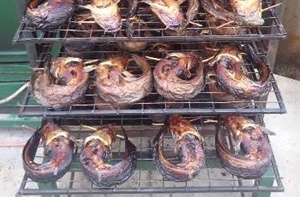
Evaluation of nutritional quality of smoked and oven dried African catfish (Clarias gariepinus) from Zobe reservoir, Katsina State, Nigeria
Abstract
This study investigated how hot-smoking and convective oven-drying affect the proximate and mineral composition of Clarias gariepinus. Significant differences were observed between the two processing methods. Thirty fresh fish samples were randomly split into two groups: 15 were smoked, and 15 were oven-dried. Proximate and mineral compositions were determined on a dry-weight basis, mineral contents were normalized to a wet-weight basis to account for differences in moisture content between processing methods, and data were all expressed as means ± SD. Data were analyzed using one-way ANOVA, and significant differences were identified with Duncan’s multiple range test at a 5% level of significance. Oven-dried fish retained higher moisture content (14.2 %) and showed increased crude protein (40.1 %) and lipid levels (22.0 %) compared with smoked samples, which were more dehydrated (5.3 %) and contained lower protein (33.7 %) and lipid (16.5 %) contents. Conversely, ash content was significantly higher in smoked fish (43.5 %) than in oven-dried samples (22.7 %). The processing method also influenced mineral composition. Oven-dried fish contained higher concentrations of calcium, magnesium, and potassium, whereas smoked samples were richer in iron and sodium. These differences are attributed to variations in dehydration intensity, heat exposure, and mineral concentration or deposition during processing. Overall, the results demonstrate that the processing technique plays a critical role in shaping the nutritional quality of preserved C. gariepinus, with important implications for dietary selection and fish processing practices.
Keywords: Clarias gariepinus, smoking, oven-drying, proximate composition, mineral content, nutrient quality
INTRODUCTION
Fish is among the most common, affordable, and accessible animal-source foods (ASF) and is often described as a “rich food for poor people” because of its nutritional richness and affordability (Obiero et al., 2019). It provides high-quality proteins, essential lipids, vitamins, and minerals required for human growth and health (Obiero et al., 2019). Fish proteins have immunogenic properties that help the body resist bacterial and viral infections (Mendivil, 2021). In addition, fish lipids, particularly the long-chain omega-3 polyunsaturated fatty acids (LC n-3 PUFAs) such as eicosapentaenoic acid (EPA) and docosahexaenoic acid (DHA), help maintain normal blood pressure, brain function, and cardiovascular health (Innes and Calder, 2020; Tacon and Metian, 2013). Despite its nutritional and economic importance, fish is highly perishable due to its high moisture content and enzymatic activity, which encourage rapid microbial spoilage after harvest (Eyo, 2001). In many low-income countries, traditional fish processing methods remain predominant; however, they often compromise the nutritional and microbiological quality of fish products (Abraham et al., 2018).
Common traditional methods such as salting, sun drying, and smoking are widely practiced by small-scale and artisanal fish processors, particularly those with limited access to improved technology or training in hygienic handling (Abraham et al., 2018). This situation often leads to nutrient losses, contamination, and reduced consumer acceptability (Cailliau, 2013; Adeyeye, 2016). Fish smoking is one of the oldest and most popular preservation methods. It involves exposing fish to smoke generated from smoldering wood or plant materials, which imparts a distinct flavour, aroma, and colour while also extending shelf life by reducing moisture content and inhibiting microbial growth (Akinneye et al., 2010). However, the nutritional quality of smoked fish may vary depending on the type of fuel wood, smoking temperature, and duration of exposure, and excessive heat may result in nutrient degradation or contamination with polycyclic aromatic hydrocarbons (PAHs) (Farid et al., 2014).
Oven drying, on the other hand, is a modern and controlled drying technique that uses regulated heat and air circulation to remove moisture from fish under hygienic conditions. Unlike traditional smoking, oven drying does not expose fish to direct smoke, thus minimizing contamination while better retaining the natural colour and nutrient composition of the product (Abulude et al., 2006). This method offers a cleaner, faster, and more standardized alternative for fish preservation, especially in urban and commercial settings.
This study was therefore conducted to evaluate the nutritional quality of oven-dried and traditionally smoked African catfish (Clarias gariepinus) obtained from Zobe Reservoir, Katsina State, Nigeria. The study compared the effects of these two processing methods on the proximate composition of the fish, particularly protein, lipid, moisture, ash, and carbohydrate contents. The findings provided valuable insights into how processing methods influence the nutritional characteristics of C. gariepinus, contributing to improved fish processing practices that enhance product quality, safety, and consumer health.
MATERIALS AND METHODS
Study Area
The study was conducted at Federal University, Dutsin-Ma (FUDMA), located within the Dutsin-Ma Local Government Area of Katsina State, in the North-Western region of Nigeria. Katsina State shares boundaries with the Niger Republic, Kaduna, Kano, and Jigawa States (Federal University Dutsin-Ma (FUDMA, 2024). Geographically, the university lies approximately between latitude 12.2953° N and 12.2957° N and longitude 7.4603° E and 7.4615° E (Umar et al., 2023). According to map data, the main campus is also located near 12.47275° N, 7.48582° E (Mapcarta, 2024).
Treatment and Experimental Design
A total of thirty (30) apparently healthy African catfish (Clarias gariepinus) were used for this study. The fish were procured from a fish farmer located by the riverside in Dutsin-Ma, Katsina State, Nigeria, and transported live to the Fish Processing unit of the Department of Fisheries and Aquaculture. Upon arrival, the fish were washed, gutted, and divided into two main processing treatments: oven drying and smoking.
The experiment was arranged in a Completely Randomized Design (CRD) with two processing methods as treatments and three replications per treatment. Each replicate consisted of five fish of approximately similar weight of 500 g for the oven-dried treatment. Fish samples were placed in a thermostatically controlled electric oven and dried at 60 °C for 24 hours until a constant weight was obtained. This treatment served as the control. For the smoked treatment, fish samples were smoked using a traditional smoking kiln fuelled with hardwood. The temperature of the smoking kiln was maintained within the range of 60–80 °C until the fish attained desirable dryness and brown coloration.
How Temperature was maintained in the smoking Kiln
The smoking process was carried out in an enclosed smoking kiln fitted with five vertical racks for placing the fish. Firewood was placed in the combustion chamber located directly beneath the lowest rack, while a chimney outlet at the top of the kiln allowed for smoke escape and airflow regulation. The temperature inside the kiln was monitored using a mercury-in-glass thermometer inserted through a side vent near the middle rack to measure the internal smoking temperature. The temperature was maintained within 60–80 °C by adjusting the quantity of firewood and regulating the air inlet and chimney opening. When the temperature tended to rise above 80 °C, the firewood was reduced or spread out to lower the heat intensity. Conversely, when the temperature dropped below 60 °C below, small pieces of firewood were added to increase the heat. The smoking continued until the fish attained desirable dryness, texture, and brown coloration. After processing, the samples were allowed to cool, packaged in airtight polyethylene bags, and stored at room temperature for subsequent nutritional analysis. Proximate composition (moisture, crude protein, crude fat, crude fiber, ash, carbohydrate and Mineral contents) were determined following the methods of the Association of Official Analytical Chemists (AOAC, 2016).
Data Analysis
Data collected from the experiment were subjected to Analysis of Variance (ANOVA). Statistical analyses were performed using the Statistical Analysis System (SAS) software, version 9.0. Where significant differences were observed among treatment means, they were separated using Duncan’s Multiple Range Test. Effects were considered statistically significant at a 5% probability level (p < 0.05).
RESULTS AND DISCUSSION
Table 1 presents the proximate composition (% dry weight) of Clarias gariepinus processed by smoking and oven-drying. The results of this study indicate that smoked fish contained significantly lower moisture content (5.33 ± 0.10%) compared to oven-dried fish (14.2 ± 1.43%). This difference is expected, as thermal processing methods such as smoking and oven drying promote moisture loss through heat exposure, thereby concentrating other proximate components, including protein and lipid fractions. Similar reductions in moisture content following smoking and drying have been widely reported in fish processing studies, where these methods consistently yield lower moisture levels than fresh or boiled fish (Oyekanmi et al., 2024). The substantial reduction in moisture is particularly important for extending shelf life, as decreased water activity (aw) limits microbial growth and slows spoilage processes.
Both smoking and oven drying resulted in an apparent increase in crude protein content of smoked fish (33.7 ± 0.25) and oven-dried fish (40.1 ± 6.14), which are relative to typical values reported for raw fish. This increase is largely attributable to moisture removal during processing, which concentrates the solid components of the fish tissue. Notably, oven-dried samples exhibited higher crude protein levels than smoked samples. This difference may be explained by the processing conditions: prolonged smoking at relatively lower temperatures can cause partial protein denaturation and drip loss, whereas oven drying promotes more uniform water removal due to uniform temperature and it will lead to minimal protein loss. Similar trends have been documented in studies on Clarias gariepinus, where oven drying consistently yielded higher protein concentrations compared to smoking or fresh fish (Adejoke Abeni et al., 2015; Okwakpam et al., 2023). Crude lipid was higher in oven-dried fish (22.0 ± 1.68) than in smoked fish (16.5 ± 0.40). This aligns with other research showing that lipid concentration increases as moisture decreases; Smoking may also promote lipid rendering and drip loss as fats melt and drain away during exposure to heat and smoke, leading to lower measured lipid content. In contrast, oven-drying involves more controlled heat with minimal fat dripping, allowing greater lipid retention in the muscle tissue. The overall trend of increased lipid proportion upon drying has been reported in forced-air or hot-air drying studies (Tenyang et al., 2022).
Ash content, an indicator of total mineral residue, is strongly affected by processing methods and moisture loss. The present study found that smoked fish had significantly higher ash content than oven-dried fish, a result consistent with Aiyeloja and Akinrotimi (2021). This elevation is likely due to the combined effects of concentrated minerals from dehydration and the direct deposition of ash-rich smoke particles onto the fish surface during smoking.
Table 2 presents the differences in mineral content between the two methods, which were significant. Oven-dried fish exhibited higher concentrations of calcium, magnesium, and potassium, while smoked samples showed higher sodium and iron values. The variations observed may be linked to differences in water loss, heat intensity, and possible mineral deposition from smoking materials (Bala et al., 2021; Ekundare et al., 2024).
Elevated mineral concentrations in smoked samples, especially sodium and iron, have been associated with smoke particle absorption from burning fuelwood, as reported by Aiyeloja and Akinrotimi (2021). The markedly higher potassium content observed in oven-dried samples compared to smoked fish is primarily attributable to moisture-driven concentration effects rather than actual mineral gain during processing. Potassium is a water-soluble intracellular mineral, and its apparent increase following oven drying reflects the substantial reduction in moisture content, which concentrates residual minerals per unit weight of tissue. Similar concentration effects of potassium following dehydration have been reported in dried fish and meat products (Gutema and Hailemichael, 2021). In contrast, smoking may result in partial potassium losses due to drip loss and leaching during pre-smoking handling, as well as surface volatilization of potassium salts under prolonged thermal exposure. Importantly, mineral composition was normalized to a common weight basis to account for differences in moisture content between processing methods, ensuring a valid comparison. Therefore, the observed variation reflects processing-induced concentration and redistribution rather than biochemical synthesis of potassium.
CONCLUSION
This study has shown that the processing methods commonly employed by fish processors in Katsina State significantly influence the proximate and mineral composition of African catfish (Clarias gariepinus) from Zobe Reservoir. Hot-smoking, which is widely practiced in Dutsin-Ma and surrounding rural communities, produced fish with significantly lower moisture content and higher ash, sodium, and iron levels. Oven-drying resulted in significantly higher crude protein, lipid, calcium, magnesium, and potassium contents. These findings indicate that the choice of processing method by local fish processors directly affects the nutritional characteristics of processed catfish. The results provide useful baseline information for fish farmers, processors, and extension agents in Dutsin-Ma, Katsina State on the nutritional implications of smoking and oven-drying of C. gariepinus under local conditions.
REFERENCES
Abraham B., Admassu H., Mahmud A., Tsighe N., Shui X. W., Fang Y. (2018). Effect of processing methods on nutritional and physicochemical composition of fish: A review. MOJ Food Processing & Technology, 6: 376-382.
Abulude F.O., Akinnusotu A., Oladipupo A. (2006). Effects of oven drying on the nutritional quality of Tilapia (Oreochromis niloticus). Journal of Food Technology, 4: 56–58.
Adejoke Abeni A., Ogunlade I., Funmilayo C. (2015). Effect of processing on the nutritive value of Clarias gariepinus from Isinla Fish Pond, Ado Ekiti, Nigeria. American Journal of BioScience, 3: 262–266.
Adeyeye E.I. (2016). Canning of fish: A review on its methods and effect on fish quality. Journal of Food Science and Technology, 53: 3656-3664.
Aiyeloja J.O., Akinrotimi O.A. (2021). Evaluation of smoking process on proximate composition of some marine fish species. IAR Journal of Agriculture Research and Life Sciences, 2: 1–5.
Akinneye J.O., Amoo I.A., Bakare O.O. (2010). Effect of drying methods on the nutritional composition of three species of fish (Bonga sp., Sardinella sp. and Heterotis niloticus). Journal of Fisheries International, 5: 75-77.
AOAC (2016). Official Methods of Analysis of the Association of Official Analytical Chemists (20th ed.). AOAC International.
Bala I., Yahaya A., Okonkwo J. (2021). Nutritional evaluation of smoked dried fishes from Nigeria. Nigerian Journal of Animal Production, 48: 93–102.
Cailliau N. (2013). The role of fish processing in food security: Case studies from the African continent. Journal of Food Security, 5: 24-30.
Ekundare O.V., Akintola S.L., Adeleye A.O. (2024). Effects of processing on the proximate and mineral composition of cultured and captured Clarias gariepinus from Nigeria. FUDMA Journal of Sciences, 8: 215–224.
Eyo A.A. (2001). Fish processing technology in the tropics. University of Ilorin Press, Ilorin, Nigeria.
Farid M.M., Al-Hazmi H.A. (2014). The effect of different processing techniques on the quality of fish. Journal of Aquatic Food Product Technology, 23: 185-197.
Federal University Dutsin-Ma (FUDMA). (2024). About Federal University Dutsin-Ma.
Gutema B., Hailemichael F. (2021). Proximate composition and mineral content of traditionally dried fish products from selected parts of Ethiopia. Advances in Applied Sciences, 6: 10–13.
Innes J.K., Calder P.C. (2020). Omega-6 fatty acids and inflammation. Prostaglandins, Leukotrienes and Essential Fatty Acids, 157: 102029.
Mapcarta (2024). Federal University Dutsin-Ma Map Coordinates.
Mendivil C.O. (2021). Dietary fish, fish nutrients, and immune function: A review. Frontiers in Nutrition, 7: 617652.
Obiero K., Meulenbroek P., Drexler S., Böber C., Mohan C.V., Fitzsimmons K. (2019). The contribution of fish to food and nutrition security in Eastern Africa: Emerging trends and future outlooks. Sustainability, 11: 1636.
Okwakpam F.N., Felagha I., Gbogbara M.V., Uahomo P.O. (2023). Study on the effect of different drying methods on the proximate, nutritional and mineral composition of Clarias gariepinus. European Journal of Nutrition & Food Safety, 15: 31–39.
Oyekanmi F.B., Ekundare O.V., Oyekanmi O.A. (2024). Effects of processing on the proximate and mineral composition of cultured and captured Clarias gariepinus. FUDMA Journal of Sciences (FJS), 8: 377–381.
Tacon A.G.J., Metian M. (2013). Fish matters: Importance of aquatic foods in human nutrition and global food supply. Reviews in Fisheries Science, 21: 22–38.
Tenyang N., Ateufack Mawamba L., Ponka R., Mamat A., Tiencheu B., Macaire Womeni H. (2022). Effect of cooking and smoking methods on proximate composition, lipid oxidation and mineral contents of Polypterus bichir bichir fish from far-north region of Cameroon. NFS Journal, 29: 1–9.
Umar A.A., Muhammad M.M., Sani S.S., Lawal A. (2023). Assessing the impacts of flood on the communities in Dutsin-Ma Local Government Area, Katsina State, Nigeria. FUDMA Journal of Sciences, 7: 266–274.